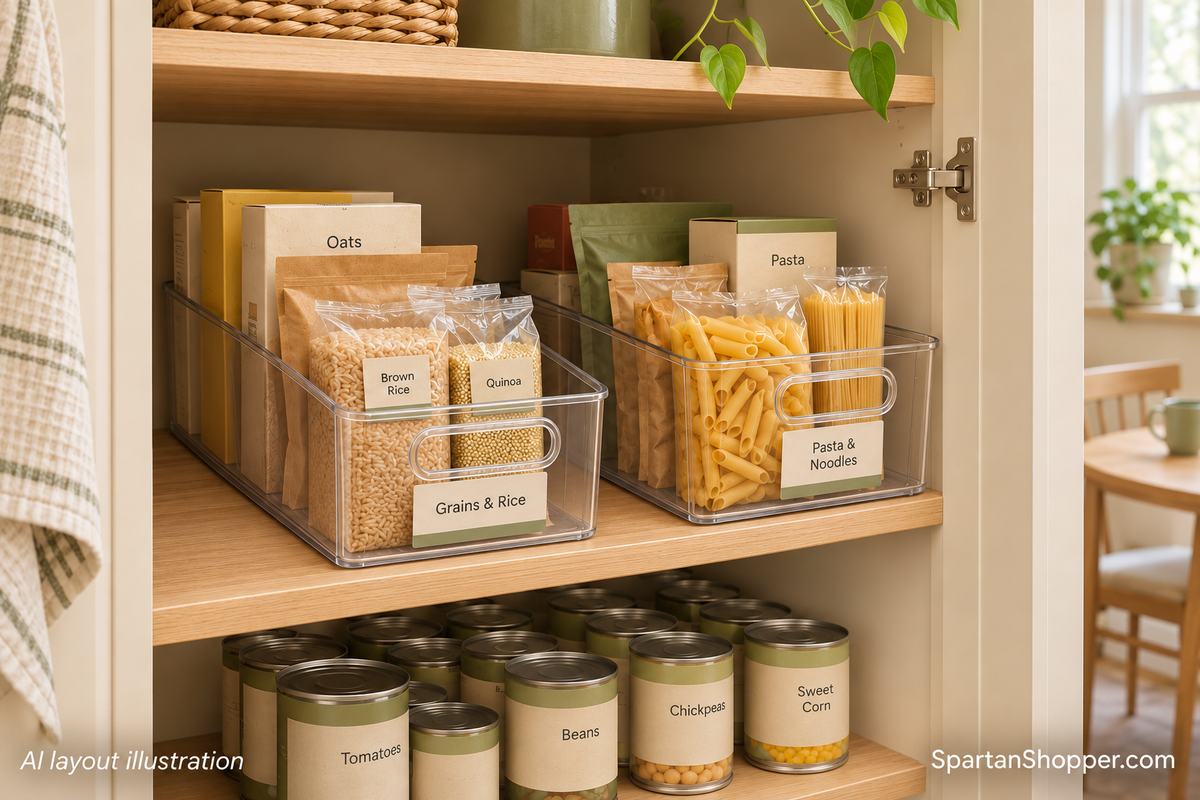
7 Small Pantry Organization Ideas That Fit Your Shelves
SpartanShopper · November 9, 2026
Make small pantry shelves easier to use with seven illustrated ideas, two organizer options, and a checklist for measuring bins, corners and door storage.
If you have to move three things to reach the pasta, your pantry needs a better route to the back. Start by grouping food by how you use it, keeping everyday items within easy reach, and measuring your shelves before buying organizers. A small pantry can work without matching jars or a complete makeover.
These seven small pantry organization ideas cover deep shelves, narrow shelves, corners, snacks, tall packets, backstock and door storage. Pick the problem that slows you down most, try a layout with containers you already have, and buy only the piece that is missing.
Affiliate disclosure: As an Amazon Associate, SpartanShopper earns from qualifying purchases. The two product buying links below are affiliate links; manufacturer links are provided as sources.
About the pictures: these are AI-generated layout illustrations with generic storage and packaging. They do not show the linked products or our own pantry. This is a researched planning guide, not a hands-on product test. Product details were checked November 9, 2026.
Choose one problem to solve first
| Your pantry problem | Start with | Check before buying |
|---|---|---|
| Food disappears at the back | 1. One removable bin per category | Shelf depth, opening width and lifting space |
| Narrow shelves become crowded | 2. Short rows with labels facing front | Actual can height and riser clearance |
| A corner is hard to reach | 3. A small turntable | Full diameter and loaded turning clearance |
| Snacks spill across shelves | 4. One everyday snack zone | Basket size and comfortable reach |
| Tall packets fall into a pile | 5. Upright packet storage | Packet width, height and divider spacing |
| Duplicates mix with everyday food | 6. A separate backstock zone | Space for your usual grocery shop |
| Light packets need a home | 7. Shallow door storage | Mounting, load limit and closed-door clearance |
1. Use removable bins to reach deep shelves
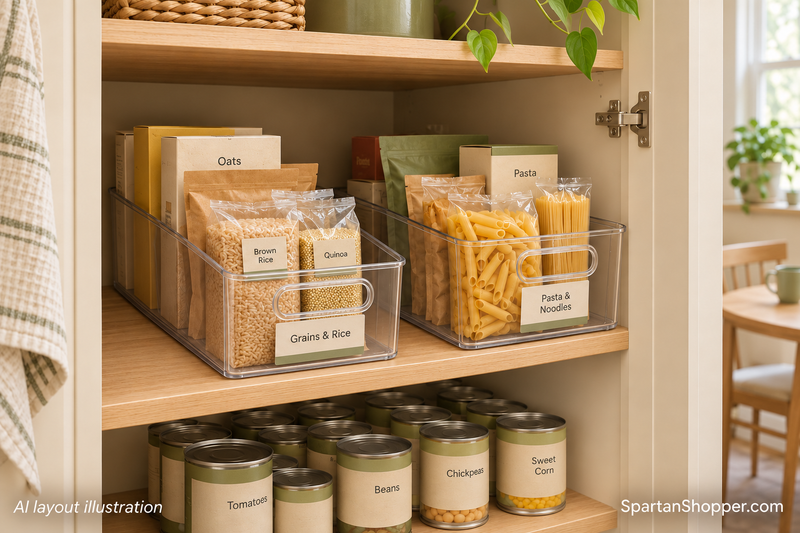
A long, narrow bin gives you a way to bring a group of packages to the front. Try one for pasta and another for breakfast supplies. Put the handle where you can reach it, leave space to lift the bin out, and keep the loaded bin light enough to carry comfortably. A bin is removable storage, not a drawer attached to rails.
Measure from the back wall to the usable front edge, including any shelf lip. Then check the narrowest opening past the door hinges. Two bins that fit side by side on the shelf might still be awkward to remove through the door. Keep each bin supported when stored; support it with your hands when removing it.
The tradeoff is that a large bin can become a heavy mixed pile. Use smaller categories and do not fill every inch. If you rarely need the rear space, put clearly labeled backup packages there instead of adding another organizer.
2. Make narrow shelves easy to scan
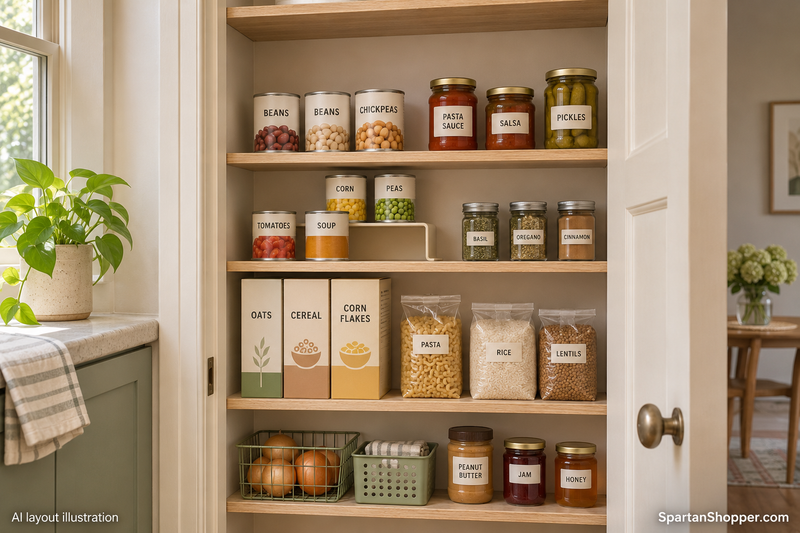
On a shallow shelf, one visible row can be more useful than two hidden rows. Group canned beans together, sauces together and breakfast boxes together. Turn labels forward and keep taller packages out of the line of sight to smaller items. You may be able to improve the layout without buying anything.
A small riser can help if there is genuinely spare height. Measure the riser plus the tallest item you will put on it, then leave room to lift that item over the front row. Check the riser’s footprint and load limit. Do not build improvised stacks of cans to create steps.
The tradeoff is capacity: a riser uses some shelf space itself. If your cans already fit neatly in a single row, keep that simple arrangement. Adjustable shelf positions, where the cabinet permits them, may solve the gap above short cans more directly.
3. Use a turntable for an awkward corner
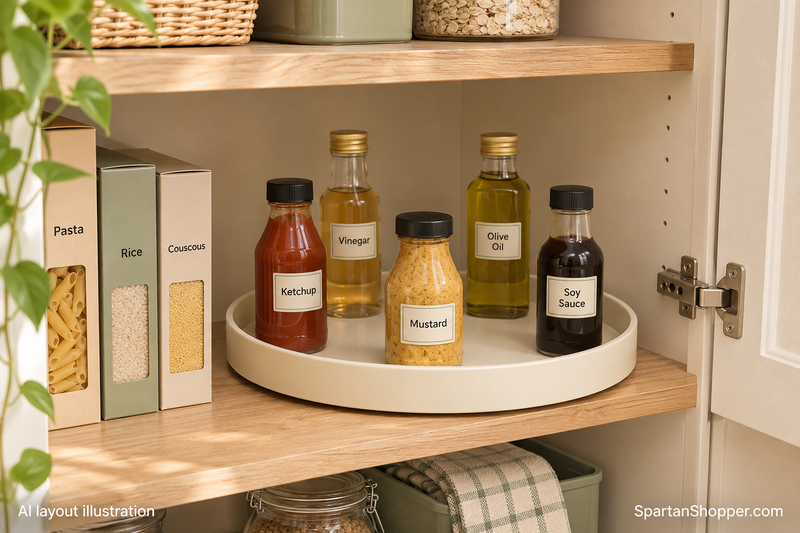
A turntable can bring a small group of bottles around to the front. It works best when you can reach the edge and rotate it without moving neighboring boxes. Use pantry-appropriate items and follow each food label’s storage instructions, including refrigeration directions after opening.
For a size reference, OXO lists its Good Grips 11-inch turntable at 11 by 11 by 1.5 inches. The tray adds height below the bottles. Check both shelf depth and width, then add the loaded bottle height and room to lift items out. The cream tray pictured here is a generic illustration, not the OXO product.
Compare the OXO Good Grips 11-inch turntable — check the selected 11-inch size and current price.
The tradeoff is unused space around a circle. Tall boxes and large bags usually suit a rectangular bin better. A turntable also cannot solve a corner whose opening is too small for your hand or the items you want to retrieve.
4. Give everyday snacks one clear home
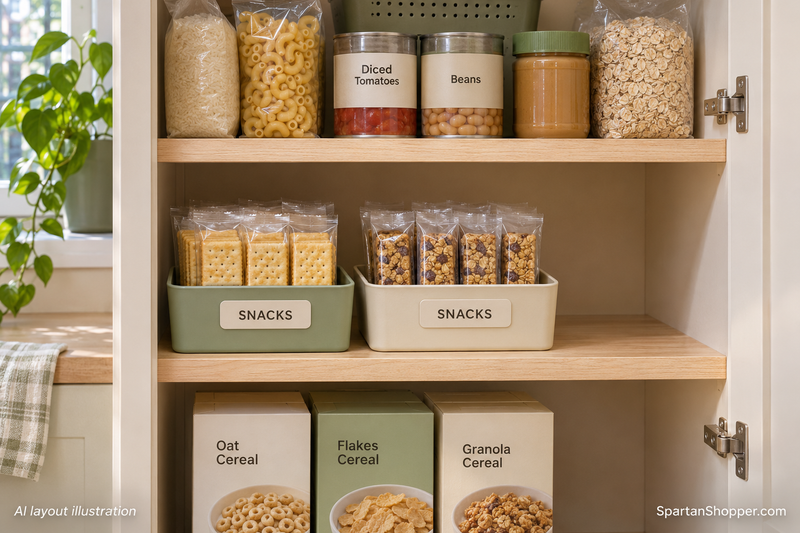
Choose one easy-to-reach shelf for the snacks your household uses regularly. A small open basket can hold wrapped bars; another can hold cracker packs. Keep the tops visible so you can see what is left without tipping everything onto the counter. Use the original individual packaging rather than pouring unrelated snacks into one bin.
Start with a basket you own. Check whether the front wall hides shorter packets, whether handles take up extra width and whether the basket can come out without snagging the shelf above. Avoid cramming a full bulk box into a basket that was sized for a few daily portions.
For small sachets and snack packets, the YouCopia ShelfBin Packet Organizer is one option to compare. Its four stepped compartments sit within an overall footprint of 10.7 inches deep by 6.5 inches wide by 5.2 inches high. It has a built-in handle and is hand-wash only. Those are exterior dimensions, not the dimensions of each compartment.
Check the YouCopia ShelfBin Packet Organizer — select the Tiered Packet Organizer variant, and compare your packet sizes before buying.
The tradeoff is that a divided organizer sets the size of each group. Wide pouches or large snack bags may fit better in a plain open basket. The baskets in the illustration are generic, not photographs of the ShelfBin.
5. Stand tall packets upright instead of stacking them
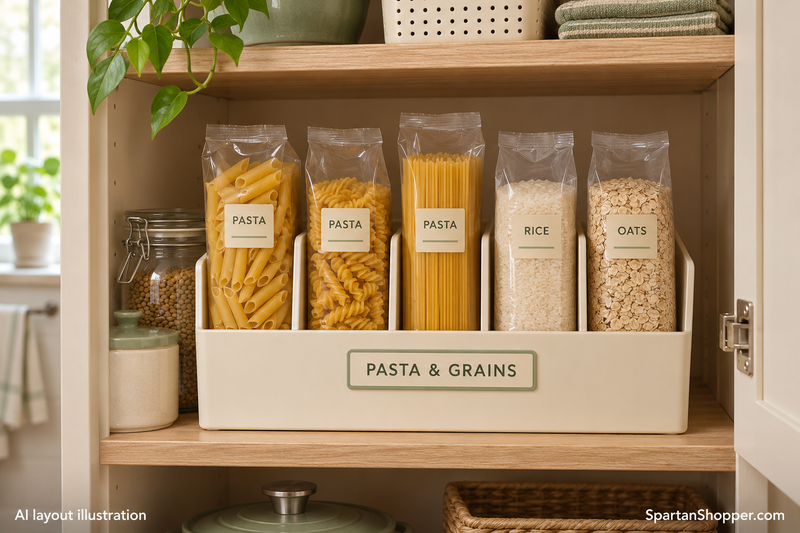
Long pasta bags and floppy grain pouches can disappear beneath one another. Stand them upright in a suitably sized bin, like files, with their names visible. A divider can stop a half-empty category falling sideways, but it should not crush the packets. Keep original labels and cooking instructions with the food.
Measure your largest packet while it is full. Check its width against the usable compartment, and check its height above the bin against the shelf opening. A small stepped packet organizer intended for sachets is not automatically suitable for tall pasta bags.
The tradeoff is that you still need room to lift a packet out. If the shelf above is too low, lay the bags in a shallow removable tray with labels visible instead. You do not need to buy a full collection of jars just to organize this category.
6. Separate backstock from the everyday row
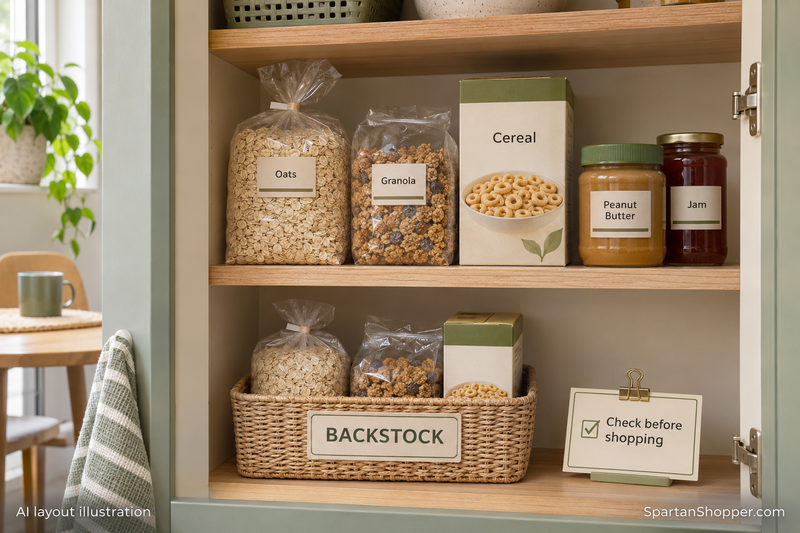
Put unopened duplicates in a labeled zone so they do not compete with the packages you use every day. Before adding cereal or pasta to your shopping list, check that zone. Move a replacement forward when you finish the current package, keeping date information visible and following the food’s storage guidance.
Size the zone for a normal grocery shop, not an imagined perfectly empty pantry. If you regularly buy a bulky multipack, allow for it in the plan. Keep heavy items on a suitably supported lower shelf and respect the cabinet’s load limits. Light, occasional supplies can use less convenient space.
The tradeoff is maintenance: a backstock basket becomes another hiding place if everything gets tossed in. Keep broad labels such as breakfast or baking, and check the contents before shopping. There is no need to buy extra food just to fill the basket.
If some of your supplies are for household readiness, Plan a practical emergency pantry-food list using foods your household already eats.
7. Use shallow door storage only when it clears
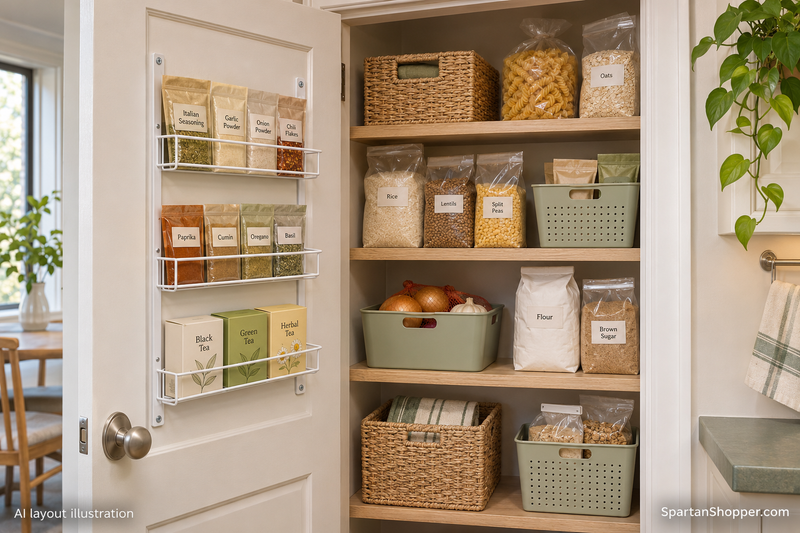
The inside of a pantry door may hold lightweight packets or tea boxes, freeing a little shelf space. Start by checking the distance between the closed door and the front of each shelf. A rack can fit on the door itself and still collide with the contents when you close it.
Check the door’s construction, the organizer’s mounting instructions, fastener requirements and load limit. A rack designed for a solid door may not suit a hollow door. If you rent, check permission before drilling. Over-door hooks also need enough clearance at the top for the door to close normally.
The tradeoff is that the contents move every time the door swings. Use suitable shallow pockets and light packages, not a collection of heavy jars. Skip this idea if the hardware or clearance is unsuitable; a small shelf bin is an easier starting point.
Save this pantry measurement checklist
Measure these three things first, then check the organizer and the way you will use it. Shelf measurements alone cannot tell you whether a loaded bin will be comfortable to remove.
- 1. Clear width: ____ Measure the shelf and its narrowest usable opening, including hinges or a center frame.
- 2. Usable depth: ____ Measure the supported shelf area and any lip; include handle projection and closed-door clearance.
- 3. Vertical clearance: ____ Measure to the shelf above. Allow for the organizer, the food inside it and room to lift items out.
- Organizer outside dimensions: ____ Usable inside or compartment dimensions: ____ Largest full package: ____
- Loaded bin easy to lift: ____ Turntable rotates without collisions: ____ Door closes normally: ____
- Mounting and load limits checked: ____ Space for the next grocery shop: ____
Hypothetical fit example: two bins that are each 8 inches wide use 16 inches across a 17-inch opening. That leaves only 1 inch in total before considering handles, hinges and room to grip them. This is a planning example, not a recommendation for an exact fit or the measurements of either linked product.
Try the layout before buying a matching set
Reset one shelf first. Group the food, use temporary labels and a container you already own, then live with the arrangement through a grocery shop. Notice what still hides at the back and what you have to move to reach breakfast. Choose an organizer for that remaining problem.
For the counter beside your pantry, See six coffee station ideas for small kitchens with layouts for trays, cupboards, carts and drawers.
For crowded drawers and cookware cupboards, Compare nine space-saving kitchen tools and check what each one actually replaces.
Sources and product checks
Layout suggestions are editorial. Product dimensions and care details were checked against the manufacturer pages below and matching retail variants on November 9, 2026. No discount, fixed price or stock guarantee is promised. Check current dimensions, variant, contents and price on the listing before ordering.
OXO 11-inch turntable specifications
YouCopia ShelfBin Packet Organizer dimensions and care
Choose soup freezer containers that fit your portions and freezer.
Get Exclusive Coupon Codes
Deals and discount codes delivered to your inbox. No spam.
Get a Free Healthy Snack Box
Gluten-free, sugar-free, better-for-you snacks. No purchase required.
Claim My Free BoxSponsored offer. No purchase necessary.