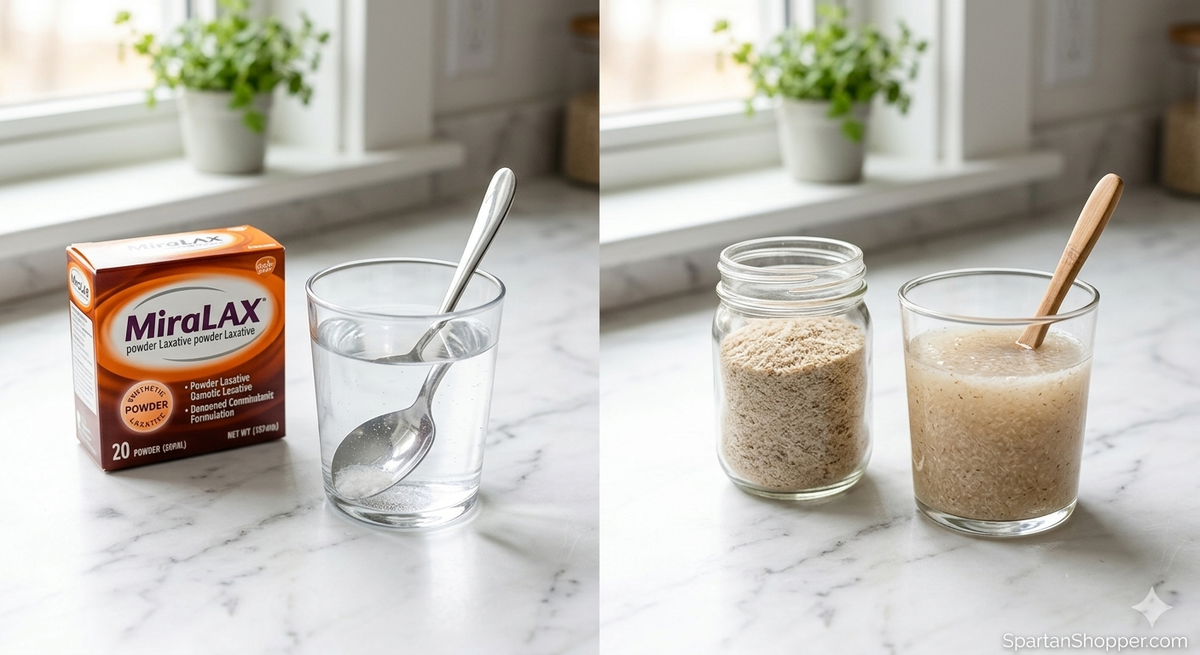
Psyllium Husk vs. MiraLax: Which Laxative Is Safest for Long-Term Relief?
SpartanShopper · May 17, 2026
If you struggle with chronic constipation, choosing the wrong laxative can make your gut dependent or cause painful bloating. Here is the direct breakdown of psyllium husk vs MiraLax so you can make the right call.
Chronic or occasional constipation eventually leads most people to the same choice in the pharmacy aisle: a natural plant-based fiber supplement, or a modern synthetic medication.
In most cases, this debate comes down to psyllium husk vs. MiraLax. Both are highly effective, both are recommended by gastroenterologists, and both can restore regular bowel movements. But they accomplish this through entirely different biological mechanisms — one works as a mechanical, dietary upgrade; the other is an engineered chemical medicine.
Understanding the difference matters because using either product incorrectly can cause bloating, cramping, or in the case of long-term laxative misuse, a genuinely sluggish colon. This guide gives you a direct comparison of how each works, their safety profiles, timelines, and exactly how to choose based on your situation.
The Core Difference: How They Work
Psyllium Husk — The Bulk-Forming Regulator
Psyllium husk is a natural soluble fiber harvested from the seeds of the Plantago ovata plant, classified as a bulk-forming laxative. When psyllium contacts fluid in your gut, it expands into a thick, lubricating gel that weaves itself into existing stool — adding soft, flexible volume that your colon recognizes as a signal to activate its natural wave-like muscular contractions (peristalsis).
Because it is a complex plant polysaccharide, psyllium also acts as a prebiotic — slowly fermenting in the lower colon to feed beneficial gut bacteria. This is the only option on this list that actively improves your microbiome while relieving constipation.
MiraLax — The Osmotic Water Magnet
MiraLax is the primary brand name for Polyethylene Glycol 3350 (PEG 3350), an osmotic laxative. Unlike fiber, MiraLax is not digested, fermented, or utilized by your gut bacteria, and it adds no physical bulk to stool. Instead, it moves through your GI tract acting as a chemical sponge — blocking your colon from absorbing fluids and forcing raw water to stay inside the bowel cavity, flooding dry, compacted stool until it softens and passes.
It is a true engineered medicine, not a dietary supplement.
For a deeper look at how psyllium husk works mechanically and the exact dosage protocol, see our full psyllium husk for constipation guide.
Related reading: psyllium husk dosage for constipation.
Timeline: How Long Does Each Take to Work?
Neither option provides the emergency evacuation of a stimulant laxative or enema, but their operational windows differ.
| Metric | Psyllium husk | MiraLax (PEG 3350) |
|---|---|---|
| Laxative type | Bulk-forming / prebiotic | Osmotic (synthetic) |
| Average timeline | 12–72 hours | 24–96 hours |
| Water source | Requires adequate external intake | Draws water from surrounding tissues |
| Best for | Daily regularity, long-term maintenance | Acute blockages, short-term relief |
| Prebiotic value | Yes | No |
A mild case of constipation can respond to psyllium husk within 24 hours when taken with adequate water. MiraLax often requires consecutive daily doses to build enough osmotic pressure to break up a dense obstruction — making it slower for standard daily regulation but more effective for an acute hard blockage.
Long-Term Safety and Habit-Forming Risk
The most common concern around regular laxative use is developing a lazy bowel — a condition where your intestines lose their natural ability to contract without chemical assistance.
Psyllium husk: not habit-forming. Because psyllium works mechanically by adding healthy natural volume to stool, your body cannot become dependent on it. The American College of Gastroenterology endorses it as a first-line option for lifelong daily regularity. There is no ceiling on how long you can safely use it.
MiraLax: low dependency risk, but with a caveat. MiraLax does not irritate intestinal nerves the way stimulant laxatives like senna or bisacodyl do, so it does not cause the classic structural dependency associated with those drugs. However, using it continuously for weeks or months without addressing the root cause — low dietary fiber and inadequate hydration — means your constipation will return the moment you stop. It treats the symptom without improving the underlying system.
Side Effects: What to Expect from Each
Because their biological pathways differ, the side effects represent two completely different structural issues.
Psyllium husk side effects
Because psyllium is a real plant fiber, your colon's native bacteria will ferment a small portion of it. Introducing a high dose too quickly triggers trapped gas, abdominal bloating, and mild cramping — typically resolving within one to two weeks as your gut adjusts. The other risk: taking psyllium without enough water causes the dry powder to absorb your body's internal moisture and swell prematurely, which can temporarily worsen a blockage rather than relieve it. Always take with a minimum of 8–12 oz of water.
MiraLax side effects
Because MiraLax uses an osmotic draw, it pulls water from surrounding muscles and tissues into the bowel. If you are already dehydrated, this can intensify systemic dehydration, cause mild electrolyte imbalances, or trigger loose, watery stools and unexpected diarrhea if overdosed. It bypasses bacterial fermentation entirely, so it rarely causes immediate gas — but it provides zero prebiotic benefit and does nothing for your microbiome.
If you regularly experience severe bloating alongside constipation, the issue may go beyond simple fiber mechanics into gut dysbiosis. Our probiotics for gut health guide covers how to restore microbiome balance alongside a fiber routine.
Can You Use Both Together?
This is the question most people actually have, and the answer is: not simultaneously, but strategically rotating them is reasonable.
Mixing them in the same dose is counterproductive — psyllium expands by absorbing water, while MiraLax forces water to stay free in the colon. Taking them at the same time can cause the fiber to bloat rapidly, leading to abdominal distension and cramping.
The smarter approach: use MiraLax for 1–3 days to break up an acute blockage, then transition to daily psyllium husk to maintain regularity and prevent the next episode. This is essentially how many gastroenterologists approach chronic constipation management — a short chemical intervention followed by a permanent dietary fiber habit.
Which Should You Choose?
Choose psyllium husk if:
- You want a permanent daily solution. If your goal is consistent, effortless regularity without ongoing medication, psyllium fiber is the right foundation.
- You want a clean, natural label. No synthetic compounds, no PEG 3350 — just plant fiber.
- Your stools are variable. Because psyllium is a metabolic stabilizer, it regulates both constipation and loose stools by absorbing excess moisture in either direction.
- You want microbiome support alongside regularity. Psyllium is the only option here that actively feeds beneficial gut bacteria.
Choose MiraLax if:
- You are dealing with an acute, hard blockage. If you haven't had a bowel movement in several days and stool feels dry and impacted, MiraLax's ability to chemically liquefy the blockage is the more effective short-term tool.
- Your gut is hypersensitive to fiber. If even small amounts of high-fiber food trigger severe gas or IBS flares, MiraLax provides temporary relief without triggering bacterial fermentation.
Frequently Asked Questions
Is MiraLax safer than psyllium husk?
Neither is inherently more dangerous than the other — they carry different risk profiles. Psyllium husk is safer for long-term daily use and carries no dependency risk. MiraLax is effective and low-risk for short-term use but is not designed as a permanent daily supplement. For ongoing constipation management, psyllium is the better long-term choice.
Which is better for pregnancy-related constipation?
Psyllium husk is the preferred first-line choice during pregnancy because it is a completely natural dietary fiber that works locally and is not absorbed systemically. MiraLax is also considered safe during pregnancy and is frequently recommended by OB-GYNs when fiber alone is insufficient. For brand-specific pregnancy protocols, see our Metamucil for constipation guide.
Can you mix MiraLax and psyllium husk together?
Not in the same dose — psyllium absorbs water while MiraLax keeps water free in the colon, and combining them can cause rapid bloating and cramping. However, rotating them strategically — MiraLax for acute relief, psyllium for daily maintenance — is a sound approach many gastroenterologists use in practice.
Does MiraLax cause lazy bowel syndrome?
No. MiraLax does not damage or desensitize colon muscles the way stimulant laxatives do. However, relying on it long-term without improving your fiber intake and hydration means constipation will return when you stop.
How long can you safely take psyllium husk every day?
Indefinitely. Psyllium husk is endorsed for lifelong daily use by the American College of Gastroenterology. Unlike stimulant laxatives, it works with your colon's existing mechanics rather than overriding them.
Final Verdict
When comparing psyllium husk vs. MiraLax, the winner depends entirely on your timeline and goal.
MiraLax is an effective chemical tool for breaking up acute, painful blockages over a short multi-day window. It belongs in your medicine cabinet for occasional disruptions — not as a daily supplement.
Psyllium husk is the superior long-term strategy. It builds true digestive health, protects colon mechanics, actively feeds your microbiome, and requires no synthetic chemistry. For anyone dealing with recurring constipation, making psyllium husk a daily habit is the structural fix — not a workaround.
SpartanShopper is reader-supported. When you buy through links on our site, we may earn an affiliate commission at no extra cost to you.
- Best pure daily fiber: Shop Organic India Whole Husk Psyllium on Amazon
- Best daily capsule option: Shop NOW Foods Psyllium Husk Capsules on Amazon
- Best for acute short-term relief: Shop MiraLax Single-Serve Packets on Amazon
Disclosure: SpartanShopper participates in the Amazon Associates Program. We may earn a small commission on qualifying purchases at no extra cost to you. This article is for informational purposes only and is not a substitute for professional medical advice. Always consult your healthcare provider before beginning a new supplement routine.
Get Exclusive Coupon Codes
Deals and discount codes delivered to your inbox. No spam.
Get a Free Healthy Snack Box
Gluten-free, sugar-free, better-for-you snacks. No purchase required.
Claim My Free BoxSponsored offer. No purchase necessary.