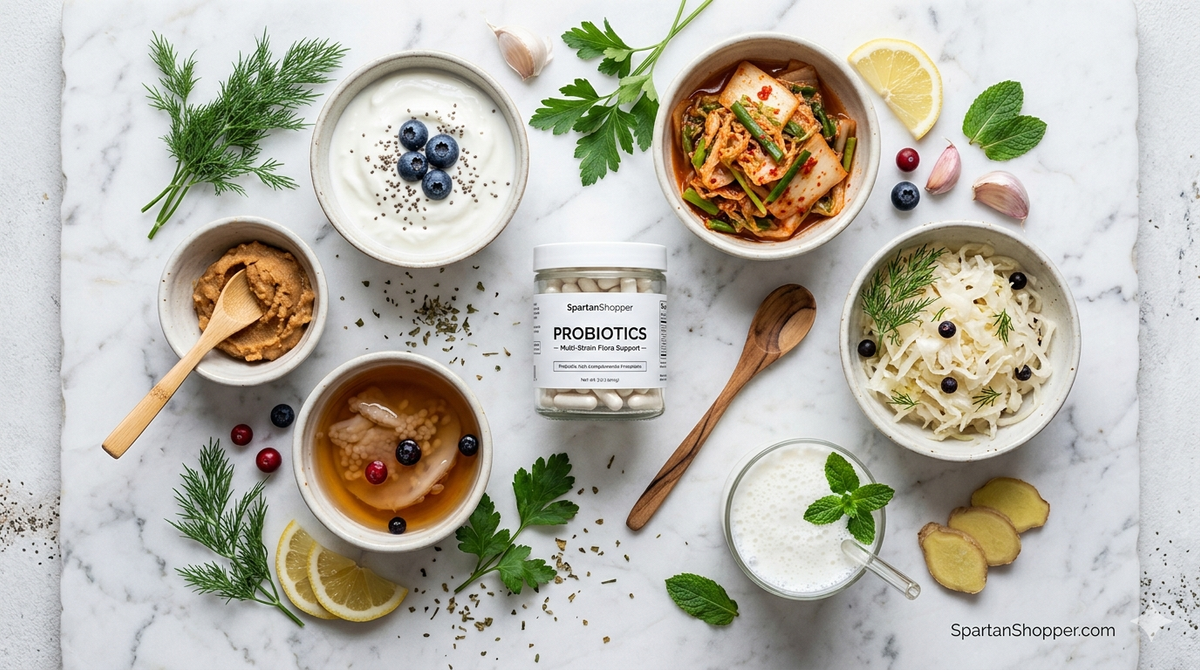
Probiotics for Gut Health: The Complete Guide for 2026
SpartanShopper · May 10, 2026
Your gut contains 100 trillion bacteria. When the balance tips the wrong way, everything suffers — digestion, immunity, energy, even mood. Here's the complete guide to using probiotics to fix it.
Your gut is home to roughly 100 trillion microorganisms — bacteria, fungi, and viruses that collectively make up your gut microbiome. When that community is balanced and diverse, digestion runs smoothly, immunity is strong, inflammation stays low, and you feel good. When it tips out of balance — a state called dysbiosis — the ripple effects reach far beyond your stomach.
Probiotics are the most researched intervention for restoring and maintaining a healthy gut microbiome. But with thousands of products on the market and an overwhelming number of strain names, CFU counts, and marketing claims, knowing what actually works is harder than it should be.
This is the complete guide to probiotics for gut health in 2026 — how they work, which strains have real clinical evidence, what to look for in a supplement, and which products are worth your money.
What Are Probiotics?
Probiotics are live microorganisms that, when consumed in adequate amounts, confer a health benefit to the host. That's the official WHO definition — and it's more precise than most supplement marketing lets on.
The key words are "live," "adequate amounts," and "health benefit." A probiotic isn't just any bacteria. It's a specific strain, at a specific dose, with demonstrated evidence of a specific benefit. This is why not all probiotic supplements are equal — and why strain selection matters far more than CFU count.
Probiotics work by temporarily colonizing the gut and interacting with your existing microbiome, your intestinal wall, and your immune system. They don't permanently replace your native bacteria — they shift the environment in ways that favor beneficial species and suppress harmful ones.
How Probiotics Support Gut Health
Restoring Microbial Balance
Dysbiosis — an imbalance between beneficial and harmful gut bacteria — is the root cause of most gut health problems. It can be triggered by antibiotics, a poor diet, chronic stress, illness, or simply the natural decline in microbiome diversity that comes with age.
Clinical studies show that specific probiotic strains, particularly Lactobacillus rhamnosus GG, Lactobacillus plantarum, and Bifidobacterium longum, help restore microbial diversity by competing with harmful species for nutrients and attachment sites in the gut wall. Less space for harmful bacteria means less gas production, less inflammation, and better digestion.
Supporting the Gut Barrier
Your intestinal wall is a single layer of cells held together by tight junction proteins. When those junctions weaken — a condition known as intestinal permeability or "leaky gut" — bacteria, toxins, and undigested food particles can cross into the bloodstream, triggering systemic inflammation.
Multiple randomized controlled trials have shown that Lactobacillus plantarum, Lactobacillus rhamnosus GG, and Saccharomyces boulardii upregulate tight junction proteins and measurably reduce intestinal permeability markers including serum zonulin. For a deeper look at this mechanism, see our guide to Probiotics for Leaky Gut.
Reducing Bloating and Gas
Excess gas is produced when bacteria ferment food in the colon. When gas-producing species outnumber beneficial ones, bloating becomes chronic and unpredictable. Lactobacillus acidophilus and Bifidobacterium lactis have the strongest evidence for reducing gas production and improving gut motility — the rate at which digested food moves through the intestine.
Clinical trials consistently show that multi-strain probiotics reduce bloating scores significantly within 4 weeks of daily use. For a focused look at this, see our guide to Probiotics for Bloating.
Producing Short-Chain Fatty Acids
Probiotic bacteria ferment dietary fiber and produce short-chain fatty acids (SCFAs) — primarily butyrate, acetate, and propionate. These compounds are the primary fuel source for colonocytes (intestinal cells), support the gut's mucus layer, reduce gut inflammation, and even influence mood and cognitive function through the gut-brain axis.
Bifidobacterium longum and Lactobacillus reuteri are particularly effective SCFA producers. This is one reason why pairing a probiotic supplement with a prebiotic fiber — like psyllium husk — produces better results than either alone. See our Psyllium Husk Supplement guide for the best fiber options to pair with your probiotic.
Modulating the Immune System
Approximately 70% of your immune system is located in and around your gut. Probiotic strains interact directly with gut-associated lymphoid tissue (GALT) and with dendritic cells — immune cells that help calibrate the body's inflammatory response.
Regular probiotic use has been shown to reduce markers of systemic inflammation, improve immune response to infections, and reduce the severity and duration of upper respiratory tract infections. The evidence is strongest for Lactobacillus rhamnosus GG and Bifidobacterium animalis in this area.
Supporting Mental Health via the Gut-Brain Axis
The gut and brain communicate bidirectionally through the vagus nerve, the enteric nervous system, and through neurotransmitters produced in the gut — including approximately 90% of the body's serotonin. This connection, called the gut-brain axis, means that gut health directly influences mood, stress response, and cognitive function.
Emerging clinical evidence shows that specific probiotic strains — particularly Lactobacillus helveticus and Bifidobacterium longum — reduce cortisol levels and anxiety scores in human trials. While this area of research is still developing, the gut-brain connection is one of the most exciting frontiers in probiotic science.
What to Look for in a Probiotic Supplement
Strain Specificity
This is the most important factor and the most commonly overlooked. The genus and species name (e.g., Lactobacillus rhamnosus) tells you very little — the strain designation (e.g., GG) tells you everything. Only specific strains have clinical evidence for specific benefits. When evaluating a probiotic, look for strain designations on the label, not just species names.
Survivability
A probiotic is only useful if it arrives in your gut alive. Standard Lactobacillus and Bifidobacterium strains can lose 99% of their viable cells before reaching the intestine due to stomach acid exposure. Look for:
- Delayed-release or enteric-coated capsules — protect strains through stomach acid
- Spore-based strains (Bacillus species) — naturally encased in protective shells, 100% survivability guaranteed
- Third-party tested CFU counts — "at time of manufacture" counts are meaningless; look for "at time of expiration" guarantees
CFU Count — Less Important Than You Think
CFU (colony-forming units) is the standard measure of probiotic dose. Most supplements range from 1 billion to 100 billion CFU. The research shows that more is not always better — a well-chosen strain at 10 billion CFU will outperform a poorly chosen formula at 100 billion CFU every time.
That said, higher CFU counts do matter for specific conditions — particularly post-antibiotic recovery and IBS, where 50+ billion CFU formulas consistently outperform lower-dose products.
Prebiotic Inclusion
Prebiotics are the fiber compounds that feed probiotic bacteria. Many high-quality probiotic supplements now include prebiotics (inulin, FOS, or GOS) in the formula — a meaningful advantage because probiotics establish faster and persist longer when they have an immediate food source.
Refrigeration vs Shelf-Stable
Refrigerated probiotics are not inherently superior to shelf-stable ones. What matters is survivability through stomach acid, not storage temperature. Spore-based probiotics are shelf-stable by nature. Many Lactobacillus and Bifidobacterium formulas now use freeze-drying technology that makes them shelf-stable without compromising viability.
The Most Evidence-Backed Probiotic Strains for Gut Health
| Strain | Best For |
|---|---|
| Lactobacillus rhamnosus GG | Leaky gut, IBS, post-antibiotic recovery, immune support |
| Lactobacillus plantarum | Bloating, gut barrier function, IBS |
| Bifidobacterium longum | Inflammation, gut-brain axis, constipation |
| Lactobacillus acidophilus | Gas, bloating, general digestion |
| Bifidobacterium lactis | Immunity, constipation, bowel regularity |
| Saccharomyces boulardii | Leaky gut, antibiotic-associated diarrhea, traveler's diarrhea |
| Lactobacillus reuteri | Mucus layer production, infant colic, H. pylori |
| Bacillus coagulans | Survivability, IBS, general gut support |
Best Probiotic Supplements for Gut Health in 2026
Just Thrive Probiotic — Best Overall
Just Thrive Probiotic sits at the top of this list for one fundamental reason: it's the only mainstream probiotic supplement that guarantees 100% of its strains arrive in your gut alive.
Just Thrive uses exclusively spore-based strains — Bacillus indicus HU36, Bacillus coagulans, Bacillus subtilis, and Bacillus clausii. These strains are naturally encased in an endospore shell that survives stomach acid completely, unlike standard Lactobacillus strains that lose the vast majority of viable cells before reaching the intestine.
Clinical studies on Just Thrive's specific strains demonstrate a 30-fold increase in bioavailability compared to leading Lactobacillus-based probiotics. Bacillus indicus HU36 is unique in that it produces antioxidants directly in the gut — a feature no other mainstream probiotic offers. This reduces oxidative stress in the intestinal lining and creates a more favorable environment for beneficial bacteria to thrive.
Just Thrive is also one of the few probiotics with clinical evidence for improving the overall diversity of the gut microbiome — not just adding strains temporarily, but shifting the long-term composition of your native bacteria. This is the difference between a supplement that works while you take it and one that produces lasting change.
4.6 stars, 2,900+ reviews. Shelf-stable, no refrigeration required.
Shop Just Thrive Probiotic on Amazon
Physician's Choice 60 Billion CFU — Best High-CFU Option
Physician's Choice 60 Billion is the most reviewed probiotic on Amazon — 141,700+ reviews, 100K+ bought per month — and consistently ranks as one of the best-value options in the category.
The formula delivers 60 billion CFU across 10 strains including Lactobacillus acidophilus, L. plantarum, L. rhamnosus, Bifidobacterium longum, and Bifidobacterium lactis. Organic prebiotics (inulin) are included to support strain establishment. Delayed-release capsules improve survivability through stomach acid.
At around $25 for 30 servings, the value proposition is hard to match. This is the best option if you want a high-CFU, multi-strain formula at an accessible price point.
4.6 stars, 141,700+ reviews.
Shop Physician's Choice on Amazon
Garden of Life Dr. Formulated — Best for Women
Garden of Life Dr. Formulated Probiotics for Women is the best option for women who want a probiotic that addresses gut health, vaginal health, and immune function simultaneously.
50 billion CFU across 16 strains, including Lactobacillus reuteri and Lactobacillus fermentum for vaginal flora balance, alongside L. plantarum and Bifidobacterium longum for gut barrier support. USDA Organic certified, non-GMO, gluten-free, dairy-free, soy-free. No refrigeration required.
The 16-strain diversity is particularly valuable — different strains target different mechanisms, and broader diversity produces more comprehensive gut health benefits than a single dominant strain.
4.6 stars, 59,600+ reviews, 100K+ bought per month.
Culturelle Pro Strength — Best Clinical Evidence
Culturelle Pro Strength is built around Lactobacillus rhamnosus GG (LGG) — the single most clinically studied probiotic strain in the world, with over 1,000 published human studies.
LGG has been shown to reduce intestinal permeability, improve bowel regularity, reduce IBS symptoms, support immune function, and prevent antibiotic-associated diarrhea. If clinical evidence depth is your priority, nothing on this list matches Culturelle's evidence base.
12 billion CFU per capsule with 200mg inulin prebiotic. 60-capsule bottle is a 2-month supply at approximately $0.50/day — the most cost-effective per-dose option on this list.
4.7 stars, 15,100+ reviews, 50K+ bought per month. #1 Top Rated in its category.
Shop Culturelle Pro Strength on Amazon
Sunergetic 4-in-1 Probiotic Prebiotic & Postbiotic — Best All-in-One Formula
Most probiotic supplements stop at strains and a prebiotic fiber. Sunergetic’s formula adds digestive enzymes and postbiotics on top — the metabolic byproducts probiotics produce once established — in one 60-capsule bottle. A reasonable pick if you’d rather cover prebiotic, probiotic, postbiotic, and enzyme support without stacking separate supplements.
How to Take Probiotics for Maximum Benefit
- Be consistent — daily use is essential. Probiotics don't permanently colonize the gut; benefits diminish within weeks of stopping
- Pair with prebiotic fiber — probiotics establish faster and produce more SCFAs when fed. Add psyllium husk, inulin, or eat plenty of vegetables. See our Psyllium Husk guide
- Time it right — spore-based probiotics (Just Thrive) can be taken any time. Lactobacillus-based probiotics survive better taken with a meal
- Give it time — most clinical studies showing meaningful gut health improvements run 4–8 weeks. Don't judge a probiotic in the first week
- Post-antibiotic protocol — take probiotics 2 hours after each antibiotic dose, then continue for at least 4 weeks after finishing the course to restore microbiome diversity
Probiotics vs Prebiotics vs Synbiotics
Probiotics are live bacteria that confer health benefits.
Prebiotics are the dietary fibers that feed probiotic bacteria — inulin, FOS (fructooligosaccharides), GOS (galactooligosaccharides), and psyllium husk are the most common.
Synbiotics combine probiotics and prebiotics in a single product. Research suggests synbiotics produce superior results to either alone because the prebiotic creates an immediately favorable environment for the probiotic strains to establish and thrive.
Many of the supplements on this list include prebiotics in the formula. If yours doesn't, adding a separate fiber supplement like psyllium husk is a simple and effective upgrade.
Side Effects and Who Should Use Caution
Most healthy adults tolerate probiotics well. A few things to know:
- Initial gas and bloating is common in the first 1–2 weeks as your microbiome adjusts — reduce dose temporarily if severe
- People with SIBO (small intestinal bacterial overgrowth) may find standard Lactobacillus probiotics worsen symptoms — spore-based probiotics like Just Thrive are generally better tolerated
- Immunocompromised individuals should consult a doctor before starting any probiotic
- People with serious gut conditions (Crohn's disease, ulcerative colitis) should work with a gastroenterologist — probiotics can be beneficial but strain selection matters significantly
Frequently Asked Questions
How long does it take for probiotics to work? Most people notice improvements in bloating and digestion within 1–2 weeks. More significant benefits — gut barrier repair, microbiome diversity, immune support — develop over 4–8 weeks of consistent daily use.
Should I take probiotics every day? Yes. Probiotics don't permanently colonize the gut. Regular daily use maintains the microbial shifts that produce health benefits. Most studies showing meaningful results run 4–12 weeks of continuous use.
Can I get enough probiotics from food alone? Fermented foods like yogurt, kefir, kimchi, sauerkraut, and miso do contain live bacteria, but strain diversity and CFU counts vary enormously and are impossible to control. Food sources are a valuable complement to supplementation, not a replacement.
Do probiotics need to be refrigerated? Not necessarily. Spore-based probiotics are shelf-stable by nature. Many Lactobacillus formulas now use freeze-drying technology that maintains viability at room temperature. What matters is survivability through stomach acid, not storage temperature.
Can I take probiotics with antibiotics? Yes — take probiotics 2 hours after each antibiotic dose to avoid the probiotic being killed by the antibiotic. Continue probiotics for at least 4 weeks after finishing the antibiotic course to support microbiome recovery.
What's the difference between probiotics and digestive enzymes? Probiotics are live bacteria that support the gut microbiome. Digestive enzymes help break down food in the stomach and small intestine. They address different aspects of digestion and can be taken together.
The Bottom Line
Probiotics are one of the most evidence-backed supplements available for gut health — but only when you choose the right strains at the right dose. CFU count and marketing claims matter far less than strain specificity and survivability.
For most people, Just Thrive is the best starting point — spore-based strains that guarantee 100% survivability and clinical evidence for genuine microbiome improvement. For a high-CFU budget option, Physician's Choice delivers exceptional value. For women, Garden of Life Dr. Formulated covers gut, vaginal, and immune health in one formula. And for the deepest clinical evidence base, Culturelle Pro Strength and its LGG strain is unmatched.
For specific gut concerns, explore our cluster guides:
- Probiotics for Bloating — the strains that target gas and digestive discomfort
- Probiotics for Leaky Gut — gut barrier repair and intestinal permeability
- Psyllium Husk Supplement Guide — the best fiber to pair with your probiotic
If reduced appetite from a GLP-1 medication is part of why digestion feels different, our guide to preserving muscle on GLP-1 medications covers the nutritional side of that transition.
Disclosure: SpartanShopper participates in the Amazon Associates Program. We may earn a small commission on qualifying purchases at no extra cost to you. This article is for informational purposes only and is not a substitute for professional medical advice.
Get Exclusive Coupon Codes
Deals and discount codes delivered to your inbox. No spam.
Get a Free Healthy Snack Box
Gluten-free, sugar-free, better-for-you snacks. No purchase required.
Claim My Free BoxSponsored offer. No purchase necessary.