Psyllium Husk for Constipation: Dosage, Timeline, and Safety Guide
Reviews

Psyllium Husk for Constipation: Dosage, Timeline, and Safety Guide

SpartanShopper · May 17, 2026

Psyllium husk is one of the most clinically validated fiber supplements on the planet — but most people take it wrong, drink too little water, and wonder why they feel worse. Here's the complete guide to using it safely and actually getting it to work.

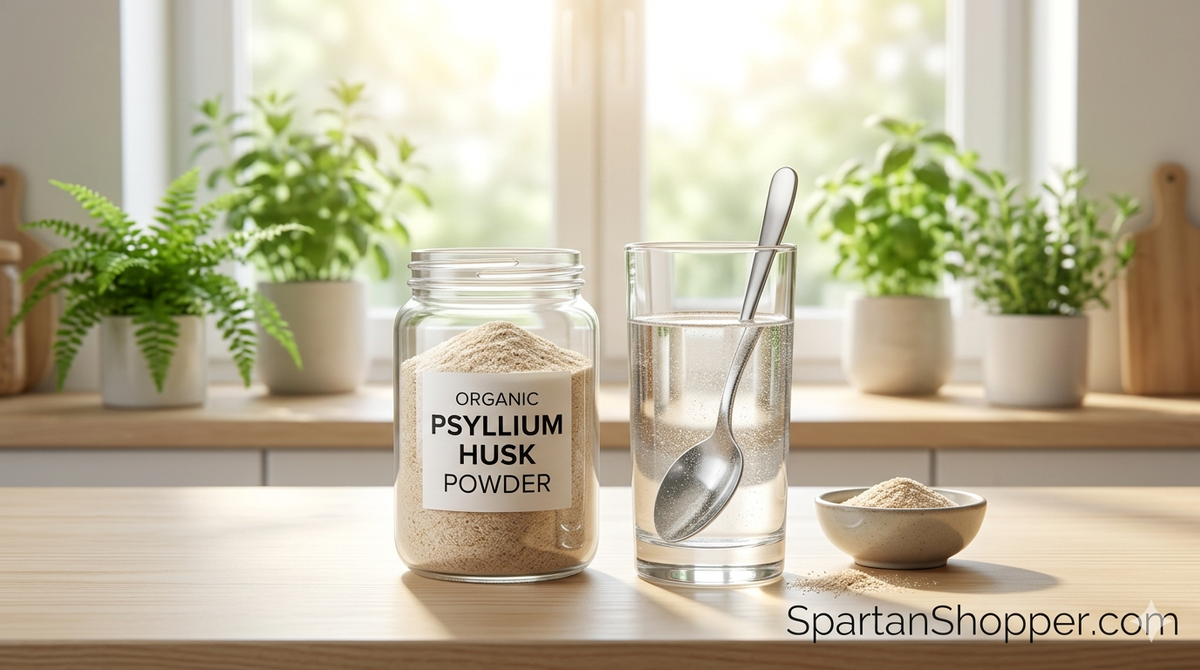
Organic psyllium husk powder in a glass jar next to a glass of water on a kitchen counter
Psyllium husk powder and capsule supplements on a white marble surface for constipation relief.

If you're dealing with constipation, psyllium husk is one of the most evidence-backed tools you have access to without a prescription. It's the active ingredient in Metamucil, it's been studied in hundreds of clinical trials, and it works by a completely different mechanism than laxatives like MiraLax. But the two biggest complaints people have — "it didn't work" and "it made me feel bloated and worse" — almost always come down to the same two mistakes: wrong dosage and not enough water.

This guide covers how psyllium husk relieves constipation, exactly how long it takes to work, the right dosage for adults, which products are actually clean, and the side effects you need to know before your first dose.

If you're also dealing with bloating or gut dysbiosis alongside constipation, our full Probiotics for Gut Health guide covers the complementary probiotic side of gut repair in depth.

What Is Psyllium Husk and Why Does It Work?

Psyllium husk is the outer shell of the Plantago ovata plant seed — a crop grown primarily in India and harvested for its dense fiber content. It's classified as a soluble, gel-forming fiber, which is the category of fiber most directly associated with regularity and stool softening.

When psyllium husk contacts water in your digestive tract, it expands and forms a thick, viscous gel. That gel does three things simultaneously:

  • Adds bulk to stool, making it easier for the colon to propel forward
  • Retains water in the stool, keeping it soft and easier to pass
  • Slows intestinal transit slightly, which smooths out the mechanical process and reduces the urgency that comes with looser stools

This is why psyllium husk works for both constipation and diarrhea — it's a regulator, not a stimulant. It doesn't force the bowel to contract the way senna or bisacodyl does. It simply creates the physical conditions for a normal bowel movement.

How Long Does Psyllium Husk Take to Work for Constipation?

This is the most searched question on this topic, and the honest answer is: 12 to 72 hours, depending on your baseline gut transit time.

Here's a more precise breakdown:

SituationExpected Timeline
Mild constipation, otherwise healthy gut12–24 hours
Moderate constipation, typical adult24–48 hours
Chronic constipation or slow transit48–72 hours
First-time user with dry stoolUp to 3 days

The single most important variable is water intake. Psyllium husk requires a minimum of 8 oz of water per dose — but 12–16 oz is better. Without adequate water, the gel cannot form properly, and the expanded husk can actually make constipation worse by creating a dry, dense mass in the colon. This is not a theoretical risk — it's why most people report that "it didn't work" in their first week.

If you're not seeing results within 72 hours on the correct dose with adequate hydration, that's a signal to assess your total daily fiber and fluid intake before increasing your psyllium dose.

Psyllium Husk Dosage for Constipation

The clinical dosage range studied in the vast majority of trials is 5–10 grams per day, typically split into one or two doses.

Standard adult dosage:

  • Starting dose: 5g (approximately 1 teaspoon of powder or 2–3 capsules) once daily
  • Maintenance dose: 5–10g daily, divided into 1–2 doses
  • Maximum dose: 30g/day in clinical settings — but there is no reason to exceed 15g/day for typical constipation management

Timing:

  • Take psyllium husk with a full glass of water, 30 minutes before a meal or before bed
  • Do not take it within 2 hours of medications — psyllium can slow the absorption of certain drugs (thyroid medications, diabetes drugs, and some antidepressants are the most commonly cited)

Powder vs. capsules:

  • Powder gives you better dose control and faster gel formation
  • Capsules are more convenient for travel and consistent daily use — just increase your water intake accordingly since each capsule contains significantly less than a teaspoon

Best Psyllium Husk Products for Constipation Relief

SpartanShopper is reader-supported. When you buy through links on our site, we may earn an affiliate commission at no extra cost to you.

Not all psyllium husk products are equal. The main differentiators are additive load (some brands add sugar, artificial dyes, or aspartame) and psyllium concentration (some are diluted with fillers). Here are the cleanest options across two formats:

NOW Foods Psyllium Husk Capsules — Best Capsule Option

NOW Foods is one of the most trusted names in third-party tested supplements. Their psyllium husk capsules contain psyllium husk powder and a gelatin or vegetarian capsule shell — nothing else. No artificial colors, no sugar, no fillers.

Each serving is 700mg per capsule, so you'll take 3–5 capsules to hit a 5g dose — which sounds like a lot but becomes routine quickly. The capsule format is ideal if you find powder textures difficult to tolerate or if you need a travel-friendly format.

  • Dose: 3–5 capsules with 12–16 oz water
  • Best for: Daily maintenance, travel use, texture-sensitive users
  • Clean label: ✅ No artificial additives

Shop NOW Foods Psyllium Husk Capsules on Amazon

Organic India Whole Husk Psyllium — Best Powder Option

Organic India sources certified organic psyllium and sells it as a whole husk powder — minimally processed, which means you're getting the fiber in its most intact form. One teaspoon delivers approximately 5g of fiber with a mild, neutral flavor that dissolves reasonably well in water or juice.

Whole husk powder has a slightly different texture than refined psyllium husk powder — it's slightly coarser and takes a bit more stirring — but the fiber content and gel-forming properties are equivalent or better.

  • Dose: 1 teaspoon in 8–16 oz water, once or twice daily
  • Best for: Pure fiber intake, cost-per-dose value, mixing into smoothies
  • Clean label: ✅ USDA Organic, no additives

Shop Organic India Psyllium Husk on Amazon

ColonBroom — Best for Constipation + Gut Health Combined

ColonBroom is a psyllium husk-based supplement that adds a prebiotic fiber blend specifically targeting gut microbiome support alongside constipation relief. It's the product to consider if your constipation is tied to broader gut issues — bloating, irregular cycle, or a history of antibiotic use that may have disrupted your microbiome.

It comes in a strawberry flavor that makes daily use easier to maintain, and the dose is clean relative to many flavored fiber supplements — no aspartame, no artificial dyes.

  • Dose: 1 scoop in 300ml water once daily
  • Best for: Constipation with concurrent bloating or gut dysbiosis
  • Clean label: ✅ No aspartame, no artificial dyes

Shop ColonBroom Fiber Supplement on Amazon

Metamucil 4-in-1 Psyllium Fiber — The Familiar Option

Metamucil is the most recognized psyllium husk brand in the world and it works — the active ingredient is identical to every other psyllium product on this list. The tradeoff is the standard formulation contains sucrose (sugar) and Yellow 6 food dye. If you're using it for occasional constipation relief and those ingredients don't concern you, it's a perfectly functional option.

If you're shopping Metamucil, look specifically for the Premium Blend or Fiber Thins varieties that reduce the sugar load, or opt for the sugar-free version which uses stevia instead.

  • Dose: 1 rounded teaspoon (5g) in 8 oz water, 1–3 times daily
  • Best for: Occasional relief, already have it at home
  • Caveat: Standard formula contains sugar and Yellow 6

Shop Metamucil Psyllium Fiber on Amazon

Psyllium Husk as a Laxative: How It Compares to Stimulant Laxatives

Psyllium husk is classified as a bulk-forming laxative — a fundamentally different mechanism than stimulant laxatives (senna, bisacodyl) or osmotic laxatives (MiraLax, lactulose).

TypeMechanismHabit-Forming?Example
Bulk-formingAdds physical bulk and water to stoolNoPsyllium husk, Benefiber
OsmoticDraws water into the colon via osmosisRareMiraLax (PEG 3350), lactulose
StimulantContracts bowel muscles directlyYes — with long-term useSenna, bisacodyl

The key advantage of psyllium husk over stimulant laxatives is safety for long-term daily use. Stimulant laxatives can cause dependency and may reduce natural bowel muscle function with chronic use. Psyllium husk has no such risk — it works with your colon's existing mechanics rather than overriding them.

For a detailed breakdown of how psyllium husk compares to MiraLax specifically, see our Psyllium Husk vs. MiraLax comparison guide.

Side Effects and Safety

Psyllium husk is well-tolerated by most adults, but there are several side effects to be aware of — especially in the first week:

Common (usually resolve in 1–2 weeks):

  • Bloating and gas — caused by gut bacteria fermenting some of the fiber. Start with a half dose for the first week to minimize this.
  • Increased fullness — expected; it's a bulking agent
  • Mild cramping — often related to insufficient water intake

Serious (rare but important):

  • Esophageal or intestinal obstruction — this is the major safety concern and it happens when psyllium is taken without enough water. Always mix thoroughly and drink the full glass immediately.
  • Allergic reactions — psyllium allergy exists, particularly in healthcare workers with occupational exposure. Symptoms include sneezing, itchy eyes, or skin reactions.

Drug interactions:

Do not take psyllium within 2 hours of:

  • Levothyroxine (thyroid medication)
  • Diabetes medications (metformin, insulin)
  • Tricyclic antidepressants
  • Blood thinners

If you take any of these, space your psyllium dose at least 2 hours away and confirm timing with your prescriber.

Frequently Asked Questions

Does psyllium husk make you poop immediately?

No. Psyllium husk is not a stimulant laxative and does not produce an urgent bowel movement. Most people see results within 24–48 hours of their first dose when taken correctly with adequate water. If you need immediate relief, a glycerin suppository or osmotic laxative like MiraLax works faster — but psyllium is the better long-term option.

Can psyllium husk make constipation worse?

Yes — if taken without enough water. Without adequate hydration, the gel cannot form properly and the husk may compact in the colon, temporarily worsening symptoms. Always take with a minimum of 8 oz of water, and aim for 12–16 oz.

How long can you safely take psyllium husk every day?

Indefinitely. Unlike stimulant laxatives, psyllium husk is safe for daily long-term use. The American College of Gastroenterology endorses dietary fiber supplementation as a first-line approach to chronic constipation management.

Is psyllium husk safe during pregnancy?

Yes — psyllium husk is one of the safest options for pregnancy-related constipation because it is not absorbed systemically. It stays in the digestive tract and acts mechanically. Always confirm with your OB, but it is generally considered safe across all trimesters.

Can I take psyllium husk if I have IBS-C?

Psyllium husk is one of the few fiber types that is well-tolerated in IBS, particularly IBS with constipation (IBS-C). Unlike insoluble fiber (wheat bran), soluble psyllium fiber is less likely to trigger IBS symptom flares. Start at a low dose and increase slowly.

Final Verdict

Psyllium husk for constipation is not a gimmick — it's a mechanically sound, clinically studied intervention that works when you take it correctly. The difference between "it worked" and "it did nothing" is almost always hydration and patience.

For most people, NOW Foods Psyllium Husk Capsules is the cleanest, most consistent daily option. If you prefer powder and want organic sourcing, Organic India Whole Husk Psyllium is the better pick. And if your constipation is part of a broader gut health picture with bloating or irregularity, ColonBroom brings in the prebiotic angle that plain psyllium doesn't.

Start at 5g, drink more water than you think you need, give it 48–72 hours, and you'll have a clear read on whether it's working.

For the full gut health picture — including probiotics, prebiotics, and the role of the microbiome in regularity — see our complete guide to probiotics for gut health.

Disclosure: SpartanShopper participates in the Amazon Associates Program. We may earn a small commission on qualifying purchases at no extra cost to you. This article is for informational purposes only and is not a substitute for professional medical advice.

Get Exclusive Coupon Codes

Deals and discount codes delivered to your inbox. No spam.

Related Coupons

20% off JUNO ENERGY

JUNO ENERGY

20% off

Verified

20% off JUNO ENERGY

Save 20% off on JUNO ENERGY products on Amazon. Use code at checkout. Expires August 31, 2026.

Expires: 9/1/2026

Shop Now →