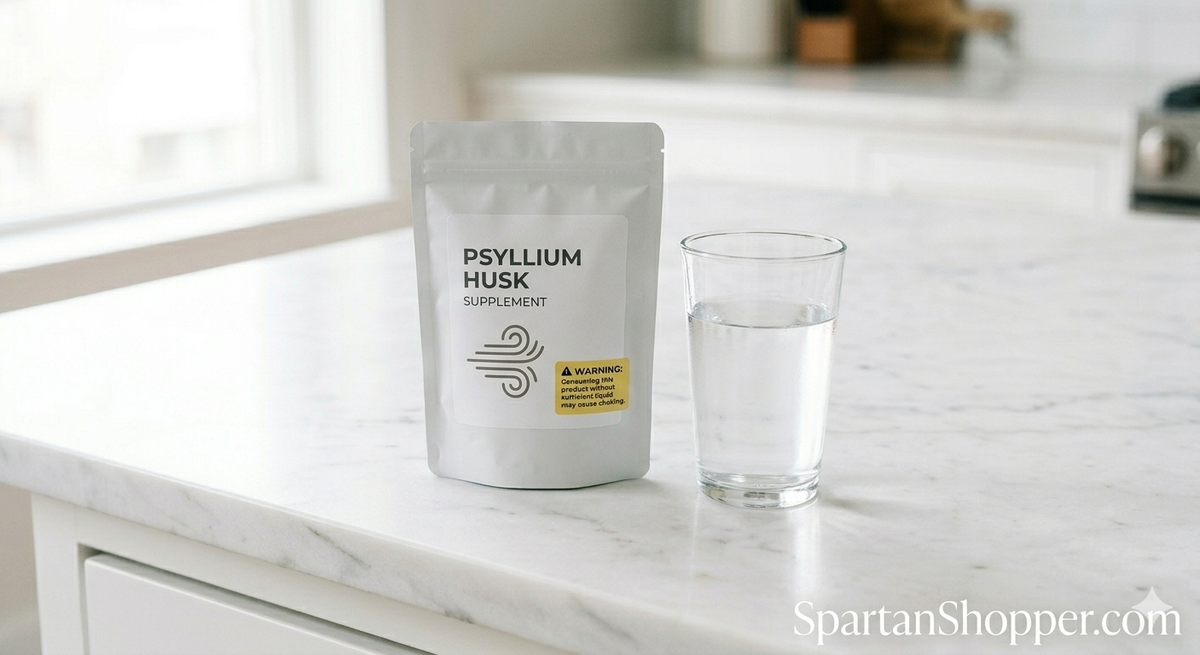
Psyllium Husk Cancer Warning: What the Label Actually Means
SpartanShopper · May 23, 2026
You bought a bag of psyllium husk, flipped it over, and saw a cancer warning label. Before you throw it out — here's what that warning actually means and why it almost certainly doesn't apply to you the way you think.
If you've ever picked up a bag of psyllium husk and noticed a cancer warning on the label, you're not alone — and your concern is completely understandable. A cancer warning on a health supplement is alarming. But before you throw it out or swear off fiber supplements entirely, it's worth understanding exactly what that warning means and where it comes from.
The short version: the warning is a California legal requirement, not a clinical determination that psyllium husk causes cancer. Here's the full picture.
What Is the Psyllium Husk Cancer Warning?
The cancer warning on psyllium husk products is a California Proposition 65 warning, also known as a Prop 65 warning. You'll see it on thousands of consumer products sold in California — everything from coffee to parking garages to certain supplements.
Prop 65 is a California law passed in 1986 that requires businesses to provide a "clear and reasonable warning" before exposing anyone to chemicals listed by the state as known to cause cancer, birth defects, or other reproductive harm. The list currently contains over 900 chemicals.
The specific chemical triggering the psyllium husk warning is lead — a naturally occurring heavy metal found in trace amounts in soil. Because psyllium husk is a plant-based product grown in soil, it can absorb small amounts of lead from the ground during cultivation.
Related reading: best psyllium husk supplements.
Does Psyllium Husk Actually Cause Cancer?
No clinical evidence links psyllium husk consumption to cancer in humans. The Prop 65 warning does not mean the product has been tested and found to cause cancer — it means the product contains a listed chemical at a level that triggers California's disclosure threshold.
Here's the critical context: the Prop 65 threshold is set extraordinarily low. California sets its warning threshold at 1/1000th of the level that has been shown to cause no observable effect in laboratory animals. The intent is to be maximally cautious, not to indicate that exposure at the listed level is actually dangerous.
The FDA, the World Health Organization, and the American College of Gastroenterology all consider psyllium husk safe for daily consumption. The FDA has actually approved a health claim for psyllium fiber, stating that 7 grams per day may reduce the risk of coronary heart disease.
A product can legally carry a Prop 65 warning while simultaneously having an FDA-approved health claim — and psyllium husk is exactly that product.
Why Does Psyllium Husk Contain Lead?
Lead occurs naturally in soil worldwide. Plants absorb it through their root systems during growth, which means virtually any plant-based food or supplement contains some trace level of lead. Wheat, rice, leafy vegetables, and many other staple foods contain detectable lead levels.
Psyllium husk is grown primarily in India and requires a specific soil type. The lead content in psyllium husk products varies by:
- Country and region of origin — soil lead levels vary geographically
- Processing method — some methods reduce heavy metal content more than others
- Third-party testing — brands that test for heavy metals can ensure their products stay below threshold levels
The trace lead found in psyllium husk is not unique to psyllium — it reflects the reality that plant-based foods grown in soil will contain naturally occurring minerals, including heavy metals in trace amounts.
Is the Prop 65 Warning Meaningful?
The Prop 65 warning system is controversial among scientists and public health experts for exactly this reason. Critics argue that the threshold is so low that it creates warnings on products with no realistic health risk, causing consumers to avoid beneficial foods and supplements unnecessarily.
The warning on psyllium husk does not mean:
- Psyllium husk has been proven to cause cancer
- The lead level in psyllium husk is dangerous
- You should stop taking psyllium husk
- The product failed safety testing
It means: a chemical on California's list is present above California's extremely conservative disclosure threshold.
How to Choose a Lower-Risk Psyllium Husk Product
If you want to minimize your lead exposure from psyllium husk — which is a reasonable thing to do even if the risk is low — here's what to look for:
Third-party testing: Choose brands that publish Certificates of Analysis (COA) showing heavy metal testing results. This is the most direct way to know what's in your product.
Sourcing transparency: Some brands disclose where their psyllium is grown. Caribbean and European sourcing tends to have lower heavy metal exposure than some South Asian sources due to soil composition differences.
Organic certification: Organic psyllium is grown without synthetic pesticides but is not automatically lower in heavy metals — lead is a naturally occurring element, not a pesticide. Don't assume organic means lower lead.
Recommended products with clean labels:
- Shop Organic India Whole Husk Psyllium on Amazon — transparent sourcing, widely tested
- Shop NOW Foods Psyllium Husk Capsules on Amazon — NOW Foods publishes COAs for their products
Should You Stop Taking Psyllium Husk Because of the Warning?
For most healthy adults, no. The clinical benefits of psyllium husk — improved regularity, reduced cholesterol, better blood sugar control, prebiotic support — are well-documented and significant. The trace lead exposure from standard doses of psyllium husk is not considered clinically meaningful by the major health bodies that have reviewed the evidence.
The populations who may want to be more cautious:
- Pregnant women — lead exposure during pregnancy warrants extra caution given fetal development concerns. Consult your OB-GYN.
- Children — children are more sensitive to lead exposure. Psyllium husk is not typically recommended for children anyway.
- People with high dietary lead exposure — if you're already consuming significant amounts of other lead-containing foods or supplements, minimizing additional sources is reasonable.
For everyone else, choosing a reputable brand with published third-party testing and taking psyllium at standard doses (5–10g per day) carries a risk profile that health authorities consider acceptable.
Frequently Asked Questions
Is psyllium husk safe to take every day?
Yes — psyllium husk is endorsed for daily long-term use by the American College of Gastroenterology. The Prop 65 warning reflects California's extremely conservative disclosure threshold, not a finding that daily use is dangerous.
Which psyllium husk brands don't have the cancer warning?
Any psyllium husk product sold in California is legally required to carry the Prop 65 warning if its lead content exceeds California's threshold, regardless of brand. A brand that doesn't display the warning is either not selling in California or has lead levels below the threshold — the latter is preferable and achievable through careful sourcing and testing.
Does Metamucil have the cancer warning?
Yes — Metamucil and other major psyllium husk brands carry the Prop 65 warning on products sold in California for the same reason. The warning is category-wide, not specific to one manufacturer.
Is the lead in psyllium husk the same as lead paint?
No. Lead paint contained extremely high concentrations of lead compounds deliberately added for paint properties. The lead in psyllium husk is a trace naturally occurring element absorbed from soil — the quantity and context are entirely different.
What is the safe daily dose of psyllium husk?
The standard clinical dose is 5–10 grams per day. The FDA-approved health claim for heart disease risk reduction is based on 7 grams per day. These doses are considered safe for daily long-term use by healthy adults.
Final Verdict
The psyllium husk cancer warning is a California Prop 65 label triggered by trace naturally occurring lead — not a finding that psyllium husk causes cancer or poses a meaningful health risk at normal doses. The FDA, WHO, and American College of Gastroenterology all consider psyllium husk safe for daily use.
If you want to minimize your exposure, choose a brand with published third-party heavy metal testing. But for most healthy adults, the well-documented benefits of psyllium husk — regularity, cholesterol reduction, blood sugar support — significantly outweigh the trace lead exposure at standard doses.
For the complete guide on how to use psyllium husk safely and effectively, see our psyllium husk for constipation guide.
Disclosure: SpartanShopper participates in the Amazon Associates Program. We may earn a small commission on qualifying purchases at no extra cost to you. This article is for informational purposes only and is not a substitute for professional medical advice. Always consult your healthcare provider before beginning a new supplement routine.
Get Exclusive Coupon Codes
Deals and discount codes delivered to your inbox. No spam.
Get a Free Healthy Snack Box
Gluten-free, sugar-free, better-for-you snacks. No purchase required.
Claim My Free BoxSponsored offer. No purchase necessary.