Psyllium Husk and Bloating: Does It Cause It or Cure It? (2026)
Gut Health

Psyllium Husk and Bloating: Does It Cause It or Cure It? (2026)

SpartanShopper · July 18, 2026

Psyllium husk has a split personality: half of Google is asking if it fixes bloating, the other half is asking why it caused theirs. Both are right. Here's the mechanism, the two-week rule, and the dosing fix that settles it.

Psyllium husk has a strange reputation problem: it’s one of the best-evidenced remedies for bloating, and one of the most-Googled causes of it. Both reputations are earned, and the difference between them is almost entirely about dose, water, and the first two weeks. If your jar is currently sitting in the cupboard because it “made things worse,” this is the article that gets it back out — correctly this time.

(New to psyllium entirely? Start with our complete psyllium husk guide for the full benefits picture.)

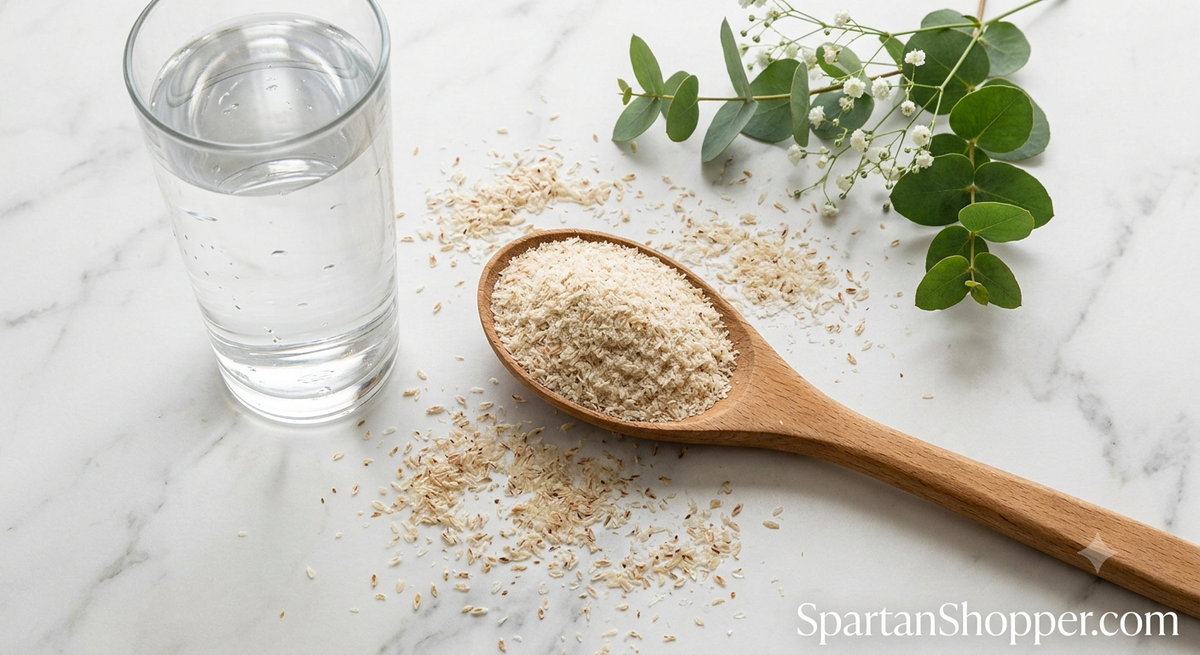
Psyllium husk powder in wooden spoon with glass of water on white marble
Psyllium husk powder in a wooden spoon beside a glass of water on white marble — the soluble fiber with a two-week bloating learning curve.

Disclosure: SpartanShopper participates in the Amazon Associates Program. We may earn a small commission on qualifying purchases at no extra cost to you.

Why Psyllium Can Cause Bloating at First

Psyllium is a soluble, gel-forming fiber. When it hits water, it swells into a soft gel that regulates transit in both directions — which is exactly why it works, and exactly why the adjustment period exists. Three things happen in a fiber-naive gut:

Your gut bacteria throw a party. Although psyllium is only minimally fermented compared to other fibers, any jump in fiber gives your microbiome more to work with, and their metabolic exhaust is gas. This is the main source of week-one bloat, and it fades as your microbial population rebalances — typically within one to two weeks.

The gel takes up room. Psyllium’s whole mechanism is bulk. If your baseline fiber intake was low, that fullness reads as “bloated” until your gut adjusts to the new normal.

You under-watered it. The classic mistake. Gel-forming fiber without enough liquid moves slowly, and slow-moving bulk means fermentation time, pressure, and discomfort. Every “psyllium made me miserable” story we’ve read starts with a heaping scoop stirred into half a glass of water.

Why Psyllium Ultimately Fixes Bloating

Stick past the adjustment window and the ledger flips. Clinical evidence consistently supports psyllium for the two conditions behind most chronic bloat: constipation (the gel softens and moves things that were sitting and fermenting) and irregular transit generally — it’s one of the few fibers with evidence in both constipation and diarrhea, which is why gastroenterologists reach for it in IBS. Less stalled material in the colon means less fermentation, which means less gas — the arithmetic most bloated people are actually trying to solve. Research shows psyllium produces less gas than most fermentable fibers (inulin and chicory root are the usual offenders in “gut health” powders), making it one of the gentler long-term choices.

The Comfortable-Start Protocol

  1. Week 1: half a teaspoon (~2.5g), once daily, in a full 12–16oz of water, followed by another glass. Yes, that little.
  2. Weeks 2–3: build toward a full teaspoon–tablespoon (5–10g) as comfort allows. If a step-up bloats you, hold that dose a few extra days — don’t retreat, don’t push.
  3. Take it with or just after a meal rather than on an empty stomach; most people find the gas noticeably milder.
  4. Not right before bed. Lying down with fresh gel is how you notice every bubble.
  5. Capsules count differently — each cap is ~0.5g, so “start low” means 2–3 caps, not the serving-size six.

Full dosing detail lives in our psyllium dosage guide, and mixing technique (the gag-free methods) in how to use psyllium husk.

When the Bloating Isn’t the Learning Curve

If bloating persists past two to three weeks at a modest, well-watered dose, stop and reassess. Persistent reactions can mean the bloat was never a fiber-shortage problem: small intestinal bacterial overgrowth (SIBO) responds badly to almost all fiber, and a genuinely distended, painful abdomen — or bloating with alarm signs like blood, weight loss, or nighttime symptoms — belongs in front of a doctor, not a supplement aisle. Psyllium is also not the tool for swallowing difficulties or any history of bowel obstruction, and it needs two-hour spacing from medications.

And if your bloat pattern reads more “microbial” than “mechanical” — comes with any diet change, worse with onions/garlic/beans — the fix may be microbiome-side rather than fiber-side; our probiotics for bloating guide covers that half of the problem.

Which Psyllium Is Gentlest?

Format matters less than dose, but texture affects compliance. Whole-husk organic psyllium gels less aggressively than fine powder and suits smoothie-mixers. Metamucil is the flavored, measured, beginner-proof option — check for the sugar-free version. Capsules make micro-dosing the start protocol easiest. And if psyllium truly isn’t your fiber, Benefiber’s wheat dextrin is the usual low-gas fallback — gentler, though with less of psyllium’s transit evidence.

FAQ

Does psyllium husk cause bloating?

Often, for the first one to two weeks — it’s an adjustment response, driven by dose jumps and too little water, not an allergy. Started low and watered well, most people pass through it with minimal drama.

How long does psyllium bloating last?

Typically 3–14 days. Persisting past three weeks at a modest dose is your cue to stop and look for an underlying cause.

Does psyllium help with bloating long-term?

For bloat rooted in constipation or sluggish, irregular transit — the most common kind — yes, with strong clinical support. For SIBO-type or highly fermentation-sensitive bloat, it can aggravate instead.

Is psyllium better than probiotics for bloating?

Different tools: psyllium fixes mechanical/transit bloat, probiotics target microbial balance. Plenty of chronic bloaters need one, not the other — and some benefit from both, started separately.

Can I take psyllium every day forever?

Yes — it’s a food-derived fiber, not a stimulant, and daily use is exactly how the cholesterol and regularity benefits accrue. Just keep the water habit permanent too.

Final Verdict

Psyllium doesn’t cause bloating so much as it charges an entry fee — one to two weeks of adjustment that a half-teaspoon start and honest water intake reduce to a rounding error. Past the gate, it’s one of the best-evidenced daily tools against the stalled-transit bloat most people actually have. Start small, drink more than feels necessary, and give it the full two weeks before you judge.

Disclosure: SpartanShopper participates in the Amazon Associates Program. We may earn a small commission on qualifying purchases at no extra cost to you. This article is for informational purposes only and is not a substitute for professional medical advice.

Get Exclusive Coupon Codes

Deals and discount codes delivered to your inbox. No spam.

Related Coupons

PharmaPrint Superfruit Extract Supplements — 20% Off

PharmaPrint

20% Off

Verified

PharmaPrint Superfruit Extract Supplements — 20% Off

Save 20% at PharmaPrint with this verified Amazon promo code.

Expires: 7/31/2026

Shop Now →
HuixinLine 3-in-1 Lumbar Massager — 50% Off with Code

Amazon

50% Off

Verified

HuixinLine 3-in-1 Lumbar Massager — 50% Off with Code

Save 50% on 3-in-1 lumbar massager heat+vibration+traction from HuixinLine. Apply code at checkout on Amazon.

Expires: 7/25/2026

Shop Now →
GparkNature NAD+ Supplement — Resveratrol & Urolithin A

Amazon

25% Off

Verified

GparkNature NAD+ Supplement — Resveratrol & Urolithin A

Save 25% on GparkNature NAD+ supplement featuring Resveratrol, Urolithin A, and CoQ10 Complex for cellular energy, healthy aging, and skin wellness.

Expires: 7/31/2026

Shop Now →