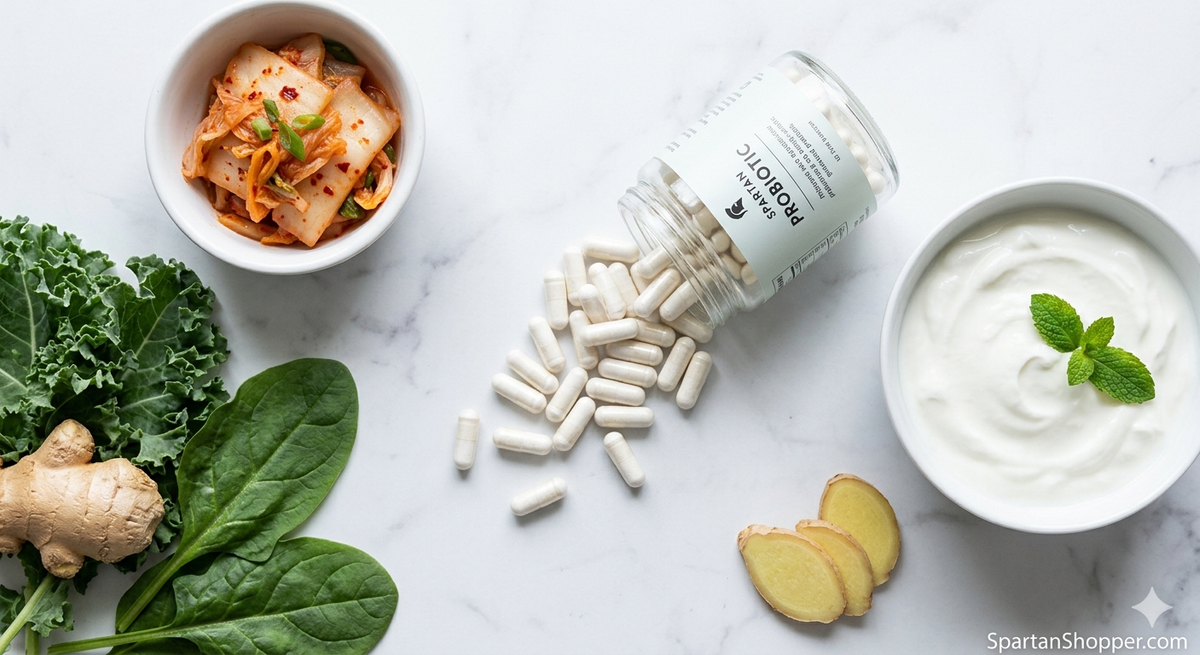
Probiotics for Leaky Gut: What the Research Actually Shows
SpartanShopper · May 10, 2026
Your gut lining is supposed to keep things out. When it stops working, everything suffers — digestion, energy, skin, even mood. Here's what probiotics actually do for leaky gut, and which ones are worth taking.
Probiotics for leaky gut is one of the most searched gut health topics of 2026 — and one of the most misunderstood. The internet is full of bold claims about probiotics "sealing" a damaged gut lining overnight. The reality is more nuanced, more interesting, and ultimately more useful if you understand what's actually happening.
This guide covers what leaky gut syndrome actually is, what the research shows about probiotics and gut barrier function, which strains are most relevant, and which supplements are worth considering in 2026.
What Is Leaky Gut Syndrome?
Leaky gut — or intestinal permeability — refers to a condition where the tight junctions between cells lining your intestinal wall become compromised. These junctions normally act as gatekeepers, allowing nutrients to pass into the bloodstream while keeping bacteria, toxins, and undigested food particles out.
When those junctions loosen, things that shouldn't cross into the bloodstream do. The immune system responds with inflammation, which can trigger a cascade of symptoms: bloating, food sensitivities, fatigue, skin issues, brain fog, and joint pain.
It's worth noting that "leaky gut syndrome" remains a somewhat contested term in mainstream medicine. The underlying mechanism — intestinal permeability — is well-documented and measurable. What's still being studied is the full extent of its role in causing systemic symptoms beyond the gut. Clinical studies suggest it's real and relevant; the science is still developing.
Can Probiotics Help Leaky Gut?
The short answer: yes, with important caveats.
Probiotics don't "seal" a leaky gut the way a patch fixes a hole. What they do is more sophisticated — and ultimately more powerful if approached consistently. The research shows probiotics support gut barrier repair through several distinct mechanisms.
Strengthening Tight Junction Proteins
Several probiotic strains have been shown in clinical studies to upregulate the proteins that form tight junctions — specifically zonulin, occludin, and claudin. These are the molecular "locks" that hold intestinal cells together. Lactobacillus rhamnosus GG and Lactobacillus plantarum have the strongest evidence here, with multiple human studies showing measurable improvements in intestinal permeability markers.
Reducing Gut Inflammation
A leaky gut is almost always an inflamed gut. Probiotic strains — particularly Bifidobacterium longum and Lactobacillus acidophilus — produce short-chain fatty acids (SCFAs) that directly reduce inflammatory cytokines in the gut lining. Less inflammation means the conditions for tight junction repair are more favorable.
Crowding Out Harmful Bacteria
Dysbiosis — an imbalance of gut bacteria — is both a cause and consequence of leaky gut. When harmful, gas-producing bacteria outnumber beneficial ones, they produce compounds like lipopolysaccharides (LPS) that directly damage the gut lining. Clinical studies suggest that restoring microbial balance with the right probiotic strains reduces LPS production and the intestinal damage that follows.
Supporting Mucus Layer Production
The gut's mucus layer is your first line of defense before tight junctions even come into play. Lactobacillus reuteri has been shown to stimulate goblet cells — the cells responsible for producing this protective mucus. A thicker, healthier mucus layer makes it harder for pathogens and irritants to reach the gut wall in the first place.
Modulating Immune Response
About 70% of your immune system lives in your gut. Probiotics interact directly with gut-associated lymphoid tissue (GALT), helping calibrate the immune response so it doesn't overreact to harmless substances crossing through a permeable gut lining. This is particularly relevant for people with food sensitivities that developed alongside leaky gut symptoms.
What the Research Actually Shows
Clinical evidence supports probiotics as a meaningful intervention for intestinal permeability — but it's not magic, and results vary significantly by strain, dosage, and the underlying cause of the leaky gut.
A 2021 systematic review published in Nutrients found that multi-strain probiotic supplementation consistently reduced markers of intestinal permeability, including serum zonulin and LPS levels, across multiple randomized controlled trials. The effect was most pronounced in people with IBS, inflammatory bowel conditions, and metabolic disorders.
Studies using Lactobacillus plantarum specifically have shown it can reduce intestinal permeability in as little as four weeks of consistent use. Saccharomyces boulardii — technically a probiotic yeast, not a bacterium — has some of the strongest evidence for leaky gut specifically, with multiple trials showing it reduces zonulin levels and supports mucosal barrier function.
The honest caveat: most human studies are short-term and use specific strains at specific doses. A supplement containing the same strain name doesn't guarantee the same results if CFU counts, survivability, or formulation differ.
Honest Limitations
Probiotics alone are unlikely to fully resolve leaky gut if the underlying triggers remain in place. Common contributors include:
- Chronic NSAID use (ibuprofen, aspirin)
- High alcohol consumption
- Chronic stress (which elevates cortisol and directly increases intestinal permeability)
- A diet high in processed foods and low in fiber
- Unaddressed food intolerances (particularly gluten for those with sensitivity)
- Dysbiosis caused by antibiotic use
The research shows probiotics consistently improve gut barrier function and reduce permeability markers. They work best as part of a broader approach that also addresses diet and lifestyle triggers.
Best Probiotics for Leaky Gut in 2026
Not all probiotics are created equal for leaky gut specifically. Here's what to look for and which products deliver on it.
What to Look For
- Spore-based strains — survive stomach acid and reach the gut alive
- Multi-strain formulas — different strains target different mechanisms
- Lactobacillus rhamnosus GG, L. plantarum, L. reuteri, Bifidobacterium longum — the most evidence-backed strains for gut barrier function
- Saccharomyces boulardii — particularly effective for leaky gut driven by antibiotics or infection
- Prebiotics included — fuel for the probiotic strains to thrive once they arrive
Just Thrive Probiotic — Best Overall for Leaky Gut
Just Thrive Probiotic is our top pick for leaky gut specifically — and it's not close.
Just Thrive uses 100% spore-based strains, meaning they arrive in the gut alive and active. Most standard Lactobacillus and Bifidobacterium strains lose 99% of their viable cells before reaching the intestine. Spore-based strains are encased in a protective shell that survives stomach acid completely — comparable to seeds that germinate only when conditions are right.
The formula includes Bacillus indicus HU36, which produces antioxidants directly in the gut — a unique feature that reduces oxidative stress in the intestinal lining. Bacillus coagulans and Bacillus subtilis round out a formula specifically designed to support gut barrier integrity and microbial balance.
Clinical studies on Just Thrive's specific strains show a 30-fold increase in bioavailability compared to leading Lactobacillus-based probiotics. For leaky gut — where getting live bacteria to the site of damage matters most — this is a meaningful advantage.
4.6 stars, 2,900+ reviews. 3,000+ bought per month.
Shop Just Thrive Probiotic on Amazon
Physician's Choice 60 Billion CFU — Best High-CFU Option
Physician's Choice 60 Billion is the most popular probiotic on Amazon by review count — 141,700+ reviews, 100K+ bought per month — and for good reason.
The formula delivers 60 billion CFU across 10 strains, including Lactobacillus acidophilus, L. plantarum, L. rhamnosus, Bifidobacterium longum, and Bifidobacterium lactis — all strains with direct evidence for gut barrier support. Organic prebiotics are included to help the strains establish and thrive.
It's shelf-stable, no refrigeration required, and formulated with delayed-release capsules to improve survivability through stomach acid. At around $25 for 30 servings, it's exceptional value for the CFU count and strain diversity.
The honest note: 60 billion CFU sounds impressive but CFU count is less important than survivability and strain specificity. Physician's Choice addresses both reasonably well for the price point.
4.6 stars, 141,700+ reviews.
Shop Physician's Choice on Amazon
Garden of Life Dr. Formulated — Best for Women
Garden of Life Dr. Formulated Probiotics for Women is formulated specifically for women's gut, vaginal, and immune health — and the strain selection reflects it.
50 billion CFU across 16 strains, including a dedicated women's blend with Lactobacillus reuteri and Lactobacillus fermentum for vaginal flora support. The formula also includes Lactobacillus plantarum and Bifidobacterium longum — two of the best-evidenced strains for gut barrier function.
It's certified USDA Organic, non-GMO, gluten-free, dairy-free, and soy-free — a clean label that matters for people already dealing with food sensitivities from leaky gut. No refrigeration required.
4.6 stars, 59,600+ reviews, 100K+ bought per month.
Culturelle Pro Strength — Best Clinically Studied Single Strain
Culturelle Pro Strength is built around Lactobacillus rhamnosus GG (LGG) — the single most clinically studied probiotic strain in existence, with over 1,000 published studies.
For leaky gut specifically, LGG has been shown to reduce intestinal permeability markers, support tight junction protein expression, and reduce systemic inflammation associated with a compromised gut barrier. If you want a probiotic with the deepest clinical evidence base, this is it.
12 billion CFU per capsule with 200mg of inulin prebiotic. The 60-capsule bottle is a 2-month supply at one capsule per day — the most cost-effective per-dose option on this list at around $0.50/day.
4.7 stars, 15,100+ reviews, 50K+ bought per month. #1 Top Rated in its category.
Shop Culturelle Pro Strength on Amazon
How to Take Probiotics for Leaky Gut
- Consistency matters more than dose — daily use for at least 4–8 weeks is needed to see meaningful changes in permeability markers
- Take with or without food — spore-based probiotics (Just Thrive) can be taken any time; Lactobacillus-based probiotics survive better when taken with a meal that buffers stomach acid
- Don't take immediately after antibiotics — wait 2 hours after any antibiotic dose to avoid the probiotic being wiped out
- Pair with prebiotic fiber — probiotics work better when fed. Consider adding psyllium husk or inulin alongside your probiotic. Our Psyllium Husk Supplement guide covers the best options
- Be patient — leaky gut develops over time and heals over time. Most clinical studies showing measurable improvement run 4–12 weeks
Side Effects and What to Expect
Most people tolerate probiotics well. A few things to expect:
- Initial bloating or gas — common in the first 1–2 weeks as your microbiome adjusts. Reduce dose temporarily if severe
- Loose stools or changes in bowel habits — usually temporary and a sign the formula is working
- People with SIBO (small intestinal bacterial overgrowth) may find standard Lactobacillus probiotics worsen symptoms — spore-based probiotics like Just Thrive are generally better tolerated in this case
- Immunocompromised individuals should consult a doctor before starting any probiotic supplement
Frequently Asked Questions
How long does it take for probiotics to help leaky gut? Clinical studies showing measurable improvements in intestinal permeability typically run 4–8 weeks. Most people notice symptom improvements — reduced bloating, improved energy, fewer food reactions — within 2–4 weeks of consistent use.
What is the best probiotic strain for leaky gut? The research points to Lactobacillus rhamnosus GG, Lactobacillus plantarum, Bifidobacterium longum, and Saccharomyces boulardii as the most evidence-backed strains for gut barrier function. Spore-based strains like those in Just Thrive offer superior survivability, making them particularly effective for reaching the intestine.
Can leaky gut be cured with probiotics alone? Probiotics meaningfully support gut barrier repair, but they work best alongside dietary changes — reducing processed foods, increasing fiber intake, and identifying any food intolerances. Probiotics address the microbial side of leaky gut; diet and lifestyle address the triggers.
Is leaky gut the same as IBS? No, though they often overlap. IBS is a functional bowel disorder defined by specific symptom criteria. Leaky gut refers to a measurable increase in intestinal permeability. Many people with IBS have elevated permeability markers, and probiotics help both conditions — particularly Lactobacillus rhamnosus GG for IBS and Lactobacillus plantarum for permeability.
Should I take prebiotics with my probiotic? Yes — prebiotics feed the probiotic strains and help them establish in the gut. Many quality probiotics include prebiotics in the formula. If yours doesn't, adding a fiber supplement like psyllium husk is a simple way to support probiotic efficacy.
The Bottom Line
The research is clear: probiotics meaningfully support gut barrier function, reduce intestinal permeability markers, and address several of the root mechanisms behind leaky gut. They're not a magic cure, but they're one of the most evidence-backed interventions available without a prescription.
For leaky gut specifically, Just Thrive is our top recommendation — the spore-based formula ensures the strains actually reach your gut alive, which is where most standard probiotics fall short. For a high-CFU budget option, Physician's Choice is hard to beat. For the deepest clinical evidence base, Culturelle Pro Strength and its LGG strain has 1,000+ studies behind it.
For comprehensive gut health support, pair your probiotic with a quality fiber supplement. Our Psyllium Husk Supplement guide covers the best options. And for the broader picture of gut health, our Probiotics for Gut Health pillar covers everything from strain selection to dosing in detail.
Disclosure: SpartanShopper participates in the Amazon Associates Program. We may earn a small commission on qualifying purchases at no extra cost to you. This article is for informational purposes only and is not a substitute for professional medical advice.
Get Exclusive Coupon Codes
Deals and discount codes delivered to your inbox. No spam.
Get a Free Healthy Snack Box
Gluten-free, sugar-free, better-for-you snacks. No purchase required.
Claim My Free BoxSponsored offer. No purchase necessary.