Wildcrafted vs Pool-Grown Sea Moss: What the Label Really Means
SpartanShopper · July 25, 2026
"Wildcrafted" has no legal definition and commands a real premium. The distinction behind it is genuine — but it is not the purity guarantee most buyers assume, and testing matters more than growing method.
"Wildcrafted" appears on nearly every sea moss product worth its price, and it commands a real premium. The term is doing more marketing work than regulatory work — it has no legal definition and no certifying body — but the underlying distinction it points at is genuine, and worth understanding before paying for the label.
Disclosure: SpartanShopper participates in the Amazon Associates Program. We may earn a small commission on qualifying purchases at no extra cost to you.
The Actual Difference
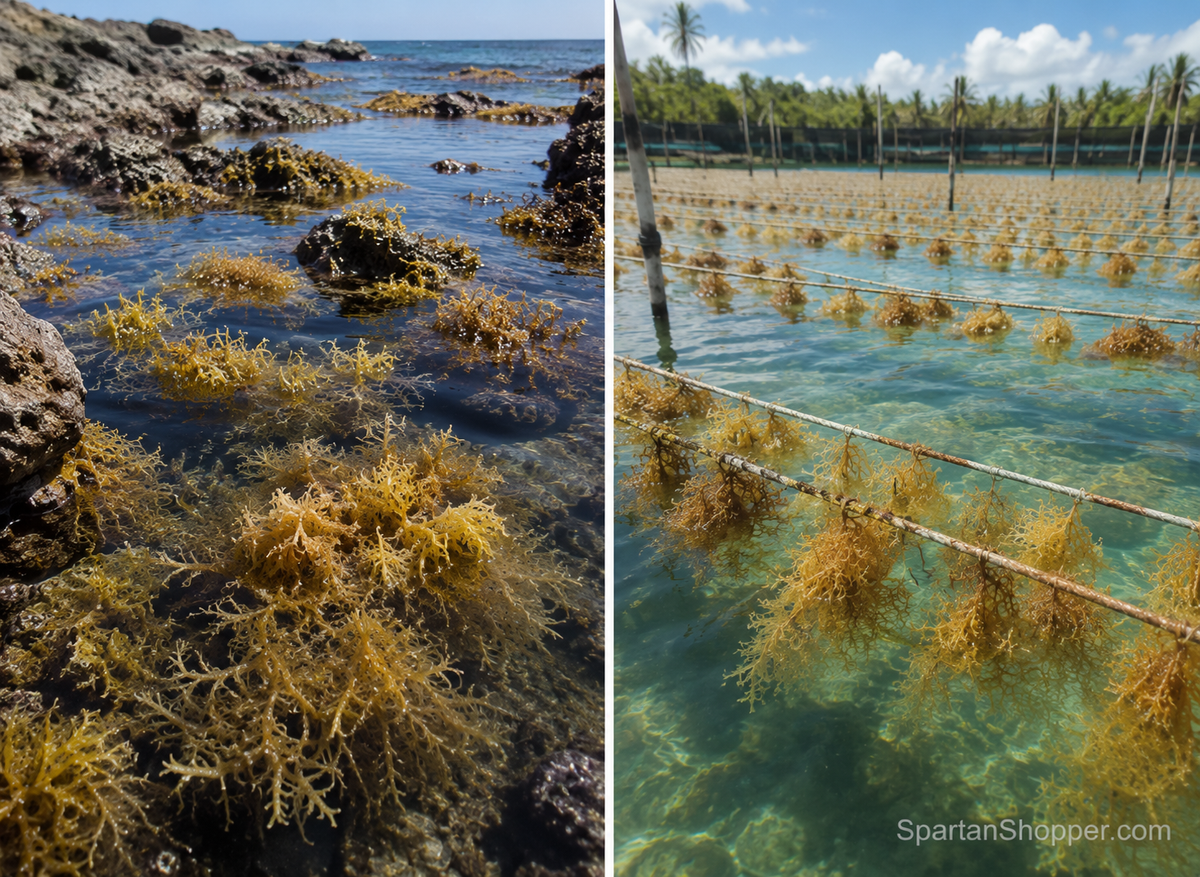
Wildcrafted sea moss is harvested from rocks in open ocean, where it grows naturally and draws minerals directly from seawater. Pool-grown sea moss is cultivated in tanks or enclosed pools, typically from fragments propagated in controlled conditions, with salt and nutrients added to the water.
The nutritional argument follows from that. Seawater contains a broad spectrum of trace minerals in the proportions the plant evolved with; a tank contains whatever was deliberately added to it. That is a real difference in mineral profile, and it is the legitimate core of the wildcrafted premium.
The argument gets overstated, though. Both are the same species, both contain the same major components, and the gap in practice is a matter of degree rather than one being nutritionally inert.
Telling Them Apart
You can often distinguish them by eye, which is unusual for a supplement claim and genuinely useful:
- Colour. Wild sea moss varies — gold, deep purple, green, or brown, often within the same batch, because sun exposure differs by depth and position. Pool-grown is typically uniform, and usually pale yellow or white.
- Thickness. Pool-grown tends to be noticeably thicker and more rubbery, a result of rapid growth in nutrient-loaded water. Wild is generally thinner and more brittle when dried.
- Salt. Heavy visible salt crystals across the surface usually indicate pool cultivation, where salt is added to mimic seawater. Wild sea moss carries some sea salt, but rarely a thick uniform crust.
- Debris. Small shell fragments, bits of rock, or ocean detritus are a good sign — they indicate the moss was actually harvested from a natural environment.
None of these is conclusive on its own. Uniformity across all four is the pattern worth being sceptical of.
The Misconception That Matters Most
Many buyers read "wildcrafted" as a purity guarantee. It is closer to the opposite.
Seaweed absorbs minerals from the water it grows in — which is the entire basis of the nutritional claim — and it does not discriminate between beneficial minerals and heavy metals. Sea moss grown in open ocean near industrial activity or polluted coastline can carry more cadmium, lead, or arsenic than sea moss grown in a controlled tank. Wild harvesting means less control over water quality, not more.
This makes third-party contaminant testing considerably more important than the growing method, and it is the question worth asking a brand before the wildcrafted one. Our guide to sea moss side effects covers heavy metal exposure and what testing to look for in more detail.
Judging a Brand: The Signals That Matter
Because the label itself is unregulated, the useful signals are the ones a brand cannot claim without evidence:
- Named harvest location. A specific coastline — St Lucia, Jamaica, Ireland — is more meaningful than "sustainably sourced from pristine waters", which is unfalsifiable.
- Published contaminant testing. Heavy metal results from an independent lab, ideally batch-specific and available without emailing customer service to ask.
- Honest appearance. Product photography showing genuine colour variation rather than uniformly bleached white moss.
- No impossible claims. The "92 of the 102 minerals the body needs" line that appears across the category has no scientific basis. A brand repeating it is telling you how carefully it checks its own copy.
VIVANUTRA’s Organic Wildcrafted Sea Moss Capsules are a useful example of the named-location signal above — sourced specifically from Nova Scotia rather than a generic “wild-harvested” claim, in capsule form at 1,476mg per serving.
The Practical Recommendation
Treat wildcrafted as a mild positive rather than a decisive one. A tested, transparently sourced pool-grown product is a better purchase than an untested wild one at twice the price — and given the label is unverifiable, transparency about testing is the more reliable signal of a brand worth trusting.
If a product is genuinely wildcrafted, tested, and openly sourced, that is the combination worth paying for. Any one of the three alone is not.
Frequently Asked Questions
Is wildcrafted sea moss genuinely better than pool-grown?
For mineral content, generally yes — ocean-grown sea moss draws from seawater containing the full range of trace minerals, while pool-grown is cultivated in tanks where minerals must be added. The gap is real but often overstated in marketing, and "wildcrafted" is not a certified or regulated term, so the label alone guarantees nothing.
Can you tell them apart by appearance?
Often, yes. Pool-grown tends to be uniformly pale or white, thick, and frequently coated in visible salt crystals from the growing tanks. Wild sea moss is usually darker and more variable — gold, purple, or deep green — thinner-stemmed, and often carries small shell fragments or ocean debris. Neither test is definitive, but uniformity is a reasonable warning sign.
Does wildcrafted mean it is free of heavy metals?
No, and this is the most common misconception. Wild sea moss grows in open ocean and absorbs whatever is in that water, including heavy metals — so wild harvesting can mean more contamination exposure, not less. Third-party contaminant testing matters far more than the wildcrafted label.
Is pool-grown sea moss worth buying at all?
It can be, if the alternative is an unverified "wildcrafted" claim at triple the price. Pool cultivation is a legitimate farming method, and a tested pool-grown product from a transparent brand beats an untested wild one. Judge the brand's testing and sourcing disclosure ahead of the growing method.
The Bottom Line
The wildcrafted distinction is real but smaller than its price premium suggests, and it is not a safety guarantee — if anything, wild harvesting means less control over the water the moss absorbed. Buy on published contaminant testing and named sourcing first, growing method second, and treat any brand repeating the "92 minerals" claim with suspicion regardless of what else the label says.
For forms, dosing, and specific product recommendations, see our sea moss supplement guide.
Disclosure: SpartanShopper participates in the Amazon Associates Program. We may earn a small commission on qualifying purchases at no extra cost to you. This article is for informational purposes only and is not a substitute for professional medical advice.
Get Exclusive Coupon Codes
Deals and discount codes delivered to your inbox. No spam.
Get a Free Healthy Snack Box
Gluten-free, sugar-free, better-for-you snacks. No purchase required.
Claim My Free BoxSponsored offer. No purchase necessary.