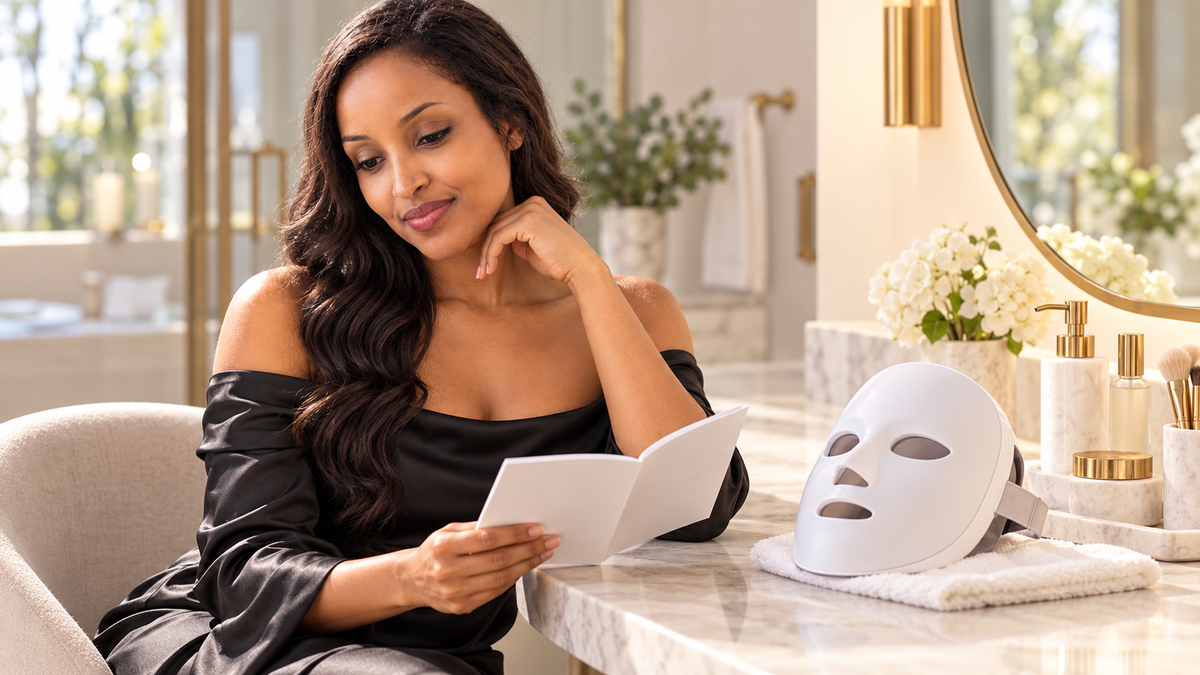
At-Home LED Light Therapy Mask Routine: How to Get the Best Results
Reviews

At-Home LED Light Therapy Mask Routine: How to Get the Best Results

June 7, 2026

You bought the LED mask. Now what? Most people use theirs wrong — wrong timing, wrong products layered underneath, inconsistent sessions. Here's the exact routine that gets results.

You did the research, made the investment, and now your LED face mask is sitting on the bathroom counter. The question most people don't ask until after they've bought one: how exactly do you use it to get the results you saw in the before-and-afters?

At-home LED light therapy masks work — the clinical evidence is solid, and the technology is the same principle used in professional settings. But the results people get vary enormously, and the difference almost always comes down to routine. How you prep your skin, what you layer, when you use it, and how consistently you show up determines whether your mask delivers or collects dust.

This is the routine that gets results.

Step 1: Start with Completely Clean Skin

This is non-negotiable and the step most people underdo. LED light — whether red, blue, or infrared — needs to penetrate the skin to do its job. Anything sitting on the surface creates a barrier.

Before your session:

  • Double cleanse if you're wearing makeup or SPF. An oil cleanser first, then a water-based cleanser. One pass isn't enough if you've been wearing sunscreen.
  • Skip active exfoliants on session days. AHAs, BHAs, and retinol on the same skin as LED can increase sensitivity. Do your chemical exfoliation on off-days.
  • Pat dry completely. Wet skin isn't a problem for safety, but dry skin allows better light contact and more comfortable wear.

The goal: skin with nothing on it but skin.

Step 2: Apply Your Treatment Serum (The Right Ones Only)

Here's where most people get confused. The general advice online is to use your LED mask on completely bare skin. That's partially right — you want nothing blocking the light. But certain serums applied before your session can actually enhance results because LED therapy temporarily increases skin permeability, allowing actives to absorb more deeply.

Safe to apply before your session:

  • Hyaluronic acid — hydrates without blocking light, enhances comfort during wear
  • Niacinamide — works synergistically with red light for barrier support
  • PDRN serumsPDRN serums — polynucleotide serums are specifically designed to pair with light therapy; they're one of the most effective pre-session additions for skin repair and collagen support
  • Peptide serums — fine before a session; light therapy boosts their absorption

Do NOT apply before your session:

  • Retinol or retinoids — photosensitizing, increases irritation risk
  • Vitamin C (L-ascorbic acid) — can cause sensitivity under light
  • AHAs or BHAs — same issue
  • Oils or heavy occlusives — physically block light penetration
  • Benzoyl peroxide — contraindicated with light therapy

Apply your chosen serum in a thin layer, let it absorb for 60 seconds, then put on the mask.

Step 3: Use the Right Light for Your Skin Concern

Most at-home LED masks offer multiple wavelengths. Using the wrong one won't hurt you, but it won't help with your specific concern either.

  • Red light (620–700nm) — the most researched wavelength for at-home use. Penetrates into the dermis to stimulate collagen production, reduce fine lines, improve skin texture, and support overall skin repair. This is the default setting for most anti-aging goals.
  • Blue light (415–450nm) — targets the surface layer where acne-causing bacteria live. Particularly effective for active breakouts and hormonal acne. Doesn't penetrate as deeply as red.
  • Near-infrared (800–1000nm)CurrentBody LED Mask Series 2 — invisible to the eye but the deepest-penetrating wavelength. Supports cellular energy production, reduces inflammation, and accelerates healing. Premium masks combine red and near-infrared for a synergistic effect.
  • Combination/multi-color modes — most quality masks offer these. Rotating red and blue on alternate sessions, or using a mask that delivers both simultaneously, lets you address multiple concerns without overcomplicating your routine.

If your mask has a single mode, use it consistently and trust the process. The frequency and consistency of use matters more than which wavelength you're optimizing.

Step 4: Run Your Session — Timing and Positioning Matter

Session length: Most at-home masks are calibrated for 10–20 minute sessions. Follow the manufacturer's recommendation for your specific device — this isn't a case where more is better. LED light therapy has a hormetic dose-response curve: too little does nothing, the right amount drives cellular benefits, and excessive exposure can actually stress cells.

Positioning: Lie flat or sit reclined so the mask rests flush against your skin. Any gap between the LEDs and your face reduces efficacy. If your mask has adjustable straps, fit it snugly without pressure.

Eyes: Most quality LED masks are designed to be safe for closed eyes — the LEDs used are non-UV and low-intensity. However, if you have any light sensitivity or eye conditions, use the provided eye covers or keep eyes closed throughout.

What to do during your session: Nothing. This is your 10–20 minutes. Read, listen to a podcast, do breathwork. The mask is hands-free — let it work.

Step 5: Lock In the Benefits Immediately After

The window immediately post-session is when your skin is most receptive to topical products. Don't waste it.

Apply in this order within 5 minutes of removing the mask:

  1. Active serum — this is when to use your retinol, vitamin C, or any actives you skipped before the session. The enhanced permeability means deeper penetration.
  2. Moisturizer — seal everything in. A peptide-rich or ceramide moisturizer works well here.
  3. SPF (morning sessions only) — LED therapy doesn't make you photosensitive, but your post-session actives might. Sunscreen is non-negotiable if you're stepping outside.

If you're doing an evening session, your nighttime routine continues as normal after the mask.

How Often Should You Use Your LED Mask?

For most people: 4–5 sessions per week to start. This is the sweet spot for driving cumulative results without overstressing skin.

After 8–12 weeks of consistent use, many people drop to a maintenance schedule of 2–3 sessions per week once they've hit their target improvement.

Morning vs. evening: Both work. Evening has a slight edge — your skin's repair processes are most active overnight, so a nighttime session feeds directly into that cycle. But the best time is whatever time you'll actually do it consistently.

What to expect on the timeline:

  • Weeks 1–2: No visible change. The work is happening at the cellular level.
  • Weeks 3–6: Subtle improvements in texture, glow, and hydration. Some users notice reduced redness.
  • Weeks 8–12: Measurable changes in fine lines, firmness, and overall skin quality for consistent users.
  • Months 3–6: Full anti-aging and collagen-building results for daily red light users.

This is a long game. The users who quit at week four because they "don't see anything" are the ones who miss the results.

What to Avoid

A few things that undermine LED therapy results:

  • Inconsistency. Sporadic use is the most common reason people don't see results. Treat sessions like workouts — missing one is fine, missing most defeats the purpose.
  • Using actives before the session. Retinol under an LED mask is a recipe for irritation.
  • Skipping the prep cleanse. SPF residue on skin during a session is both a barrier and a potential irritant.
  • Expecting overnight results. LED therapy is cumulative. The clinical studies showing significant collagen improvement typically run 8–12 weeks.
  • Using the mask over open wounds, active cold sores, or broken skin. Wait until healed.

Building Your Full LED Routine at a Glance

Morning session:

  1. Double cleanse
  2. Apply HA or peptide serum, wait 60 seconds
  3. LED mask — 10–20 minutes
  4. Vitamin C serum
  5. Moisturizer
  6. SPF

Evening session:

  1. Double cleanse (oil + water if wearing makeup)
  2. Apply PDRN or niacinamide serum, wait 60 seconds
  3. LED mask — 10–20 minutes
  4. Retinol (if using)
  5. Moisturizer

Which LED Mask Works Best for This Routine?

The routine above works with any quality LED mask. Two worth knowing:

CurrentBody LED Mask Series 2 — the clinical benchmark for at-home LED. 132 LEDs delivering both 633nm red and 830nm near-infrared simultaneously, which is the combination most studied in clinical literature. Flexible medical-grade silicone conforms to the face for full contact. 10-minute sessions.

iRestore LED Face Mask — 360 LEDs covering red, blue, and infrared in a single device. Broader wavelength coverage makes it versatile for both anti-aging and acne concerns. Good option if you're dealing with both simultaneously.

For a full comparison of the top options including budget picks, see our roundup of the best FDA-cleared LED face masks of 2026.

FAQ

Can I use my LED mask every day?

Yes, for most devices. Start with 4–5 times per week and assess your skin's response. Daily use is appropriate for many users after the initial adjustment period.

Do I need to use serums with my LED mask?

No — the mask works on bare skin. But layering compatible serums (HA, niacinamide, PDRN) before your session and actives immediately after maximizes results significantly.

Can I use retinol the same night as my LED mask?

Yes — just apply retinol after your session, not before. The post-session window is actually ideal timing for retinol absorption.

How long until I see results?

Most people notice texture and glow improvements around weeks 3–6. Measurable anti-aging results typically appear at 8–12 weeks with consistent use.

Is LED light therapy safe for all skin tones?

Yes. Unlike laser treatments, LED therapy doesn't carry risks associated with melanin levels. It's safe across all Fitzpatrick skin types.

Can I use my LED mask if I'm pregnant?

Most manufacturers advise against it due to lack of clinical data in pregnant populations, not because of known harm. Check with your OB before using.

Final Thought

An LED face mask is a tool — and like any tool, it works proportionally to how well you use it. The science is real, the results are real, but they require a consistent routine built around clean skin, the right serums, and enough patience to let the cellular work compound over weeks.

Run the routine. Give it 12 weeks. The before-and-after you're hoping for is on the other side of consistency.

Disclosure: SpartanShopper participates in the Amazon Associates Program. We may earn a small commission on qualifying purchases at no extra cost to you. This article is for informational purposes only and is not a substitute for professional medical advice.

Get Exclusive Coupon Codes

Deals and discount codes delivered to your inbox. No spam.

Related Coupons

HQMPHQ Professional Nail Drill Kit — 40% Off with Code

Amazon

40% Off

Verified

HQMPHQ Professional Nail Drill Kit — 40% Off with Code

Save 40% on Professional nail drill 45000RPM 11-bit kit from HQMPHQ. Apply code at checkout on Amazon.

Expires: 7/12/2026

Shop Now →
KYNOVEX Teeth Whitening Kit with LED — 30% Off with Code

Amazon

30% Off

Verified

KYNOVEX Teeth Whitening Kit with LED — 30% Off with Code

Save 30% on Teeth whitening kit LED PAP formula from KYNOVEX. Apply code at checkout on Amazon.

Expires: 7/31/2026

Shop Now →
7MAGIC 7-in-1 Hot Air Styler — 30% Off with Code

Amazon

30% Off

Verified

7MAGIC 7-in-1 Hot Air Styler — 30% Off with Code

Save 30% on 7-in-1 hot air styler auto-wrap curlers from 7MAGIC. Apply code at checkout on Amazon.

Expires: 8/31/2026

Shop Now →